


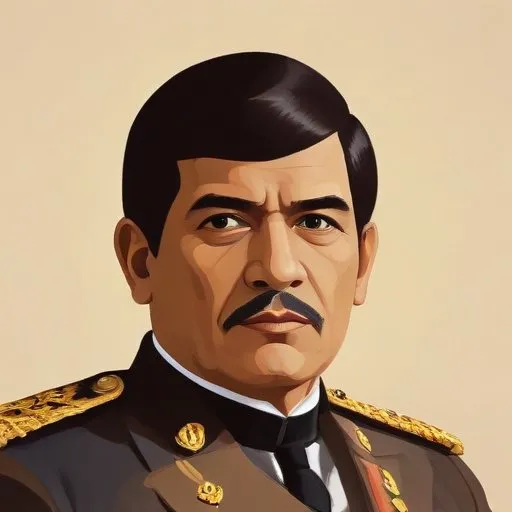
Led a left-wing military coup, implementing radical reforms and nationalizing key industries, earning a reputation as a champion of the poor and a thorn in the side of foreign corporations.
Juan Velasco Alvarado, a Peruvian general, is renowned for leading a successful coup d'état against President Fernando Belaunde in 1968, becoming the President of Peru and implementing nationalist and left-leaning policies that addressed the needs of indigenous Peruvians. His presidency was marked by significant reforms, including nationalization and agrarian reform, which aimed to reduce the country's dependence on foreign powers.
Born on June 16, 1910, in Castilla, a city near Piura on Peru's north coast, Velasco grew up in a family of 11 children. He described his youth as one of "dignified poverty," where he worked as a shoeshine boy in Piura. In 1929, he stowed away on a ship to Lima, Peru, and joined the Peruvian Army as a private. A year later, he took a competitive exam for entrance into the Escuela Militar de Chorrillos, where he graduated with high honors and at the head of his class in 1934.
In 1968, Velasco led a successful coup d'état against President Fernando Belaunde, taking advantage of the political instability and disputes between the President and Congress. During his presidency, Velasco implemented a range of policies aimed at reducing Peru's dependence on foreign powers, including the nationalization of key industries and the implementation of agrarian reform. He also strengthened Peru's relations with the Soviet Union, while maintaining a firm anti-communist stance.
Velasco's foreign policy was characterized as a "third way," which sought to distance Peru from the influence of the United States and promote greater autonomy for Latin American states. He was critical of what he perceived as the pernicious dependence of Latin American states on the United States and sought to renegotiate treaties and promote greater regional cooperation.
Velasco's presidency was marked by significant controversy, including allegations of human rights abuses and the suppression of political opposition. In 1975, he was overthrown in a coup led by his Prime Minister, Francisco Morales Bermúdez, who reversed many of his policies.
Juan Velasco Alvarado's presidency had a profound impact on Peru and the region, promoting greater autonomy and self-determination for Latin American states. While his policies were often controversial, he remains an important figure in Peruvian history, remembered for his commitment to social justice and his willingness to challenge the status quo.
Born in 1912
Peruvian architect and politician who served as President of Peru, implementing significant economic and social reforms, and promoting national identity through architecture.
77 Years Old
The first democratically elected president of Peru to serve two non-consecutive terms, known for implementing neoliberal economic policies and facing corruption allegations.
88 Years Old
Peruvian engineer, academic, and politician who served as the 90th President of Peru, known for his authoritarian rule and controversial policies, including forced sterilizations and human rights abuses.
81 Years Old
Peruvian intelligence officer who led the National Intelligence Service and was a close advisor to President Alberto Fujimori, known for his corrupt and authoritarian practices. He was involved in numerous scandals, including bribery and human rights abuses.
72 Years Old
The charismatic leader who transformed Venezuela through socialist reforms and anti-imperialist rhetoric, leaving a lasting impact on the country's politics and economy.
Born in 1926
The Cuban revolutionary who led the country from 1959 to 2008, implementing socialist policies and defying US opposition, becoming an iconic figure in modern history.
Born in 1908
Chile's first democratically elected Marxist president, who implemented radical socialist reforms and nationalized key industries, but was overthrown in a CIA-backed coup.
