


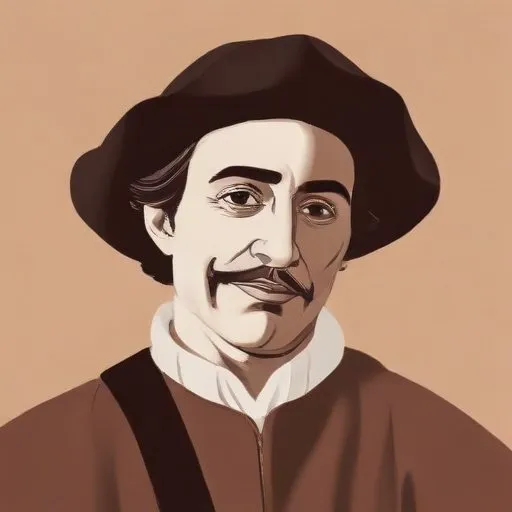
A Renaissance man who made significant contributions to Spanish literature and music, particularly in the development of the zarzuela, a form of Spanish opera.
Juan del Encina, a Renaissance man of 15th century Spain, is often credited as the joint founder or patriarch of Spanish drama, alongside Gil Vicente. This prolific composer, poet, priest, and playwright left an indelible mark on the literary and theatrical landscape of his time.
Born Juan de Fermoselle in 1468 near Salamanca, Spain, Encina was one of at least seven children of a shoemaker and his wife. Of Jewish converso descent, Encina's early life was shaped by his family's cultural heritage. After attending Salamanca University, he became a member of the household of Don Fadrique de Toledo, the second Duke of Alba, around 1492.
Encina's early career was marked by his role as a Chaplain at the Salamanca Cathedral in the early 1490s. It was during this period that he changed his name from Juan de Fermoselle to Juan del Enzina, or Encina, meaning holm oak. However, he was later forced to resign as Chaplain due to not being ordained.
In 1492, Encina penned a dramatic piece, the Triunfo de la fama, to commemorate the fall of Granada. This was followed by the publication of his Cancionero in 1496, a collection of dramatic and lyrical poems. While working for the Duke of Alba, Encina wrote pastoral eclogues, laying the foundation for Spanish secular drama. His plays are characterized by themes of shepherds and unrequited love.
Encina's ambition and drive for recognition led him to relocate to Rome around 1500, where he served in the musica. His work during this period cemented his position as a leading figure in Spanish drama.
Encina's contributions to Spanish literature and drama have had a lasting impact on the country's cultural heritage. He is remembered as a pioneer in the development of Spanish secular drama, paving the way for future generations of playwrights and poets.
Encina's contributions to Spanish drama have been recognized and celebrated throughout history, solidifying his position as a prominent figure in the country's literary heritage.
Throughout his life, Encina was driven by his ambition and passion for his craft. His decision to change his name from Juan de Fermoselle to Juan del Enzina reflected his desire to leave a lasting impact on the world.
Encina's influence can be seen in the continued development of Spanish drama and literature. His contributions have inspired generations of writers, poets, and playwrights, shaping the country's cultural landscape.
Encina's work reflects his deep understanding of human nature, love, and the human condition. His writing often explored themes of unrequited love, shepherds, and the natural world, offering insight into the human experience.
Juan del Encina's remarkable life and works continue to inspire and captivate audiences today, solidifying his position as a pioneering figure in Spanish drama and literature.
Born in 1562
Renowned playwright and poet who dominated Spain's Golden Age of theater, penning over 1,500 plays and numerous poems that still influence Spanish literature today.
Born in 1600
A 17th-century master of Spanish Golden Age theatre, he penned influential plays that explored complex moral themes, earning him a revered place in literary history.
Born in 1547
Author of the timeless classic "Don Quixote", a foundational work of modern Western literature that has shaped the literary canon and influenced countless writers and artists.
Born in 1453
A renowned Spanish general who led successful military campaigns in Italy, earning the nickname "The Great Captain" for his innovative tactics and victories. He's most known for his conquests in Naples and Sicily.
