


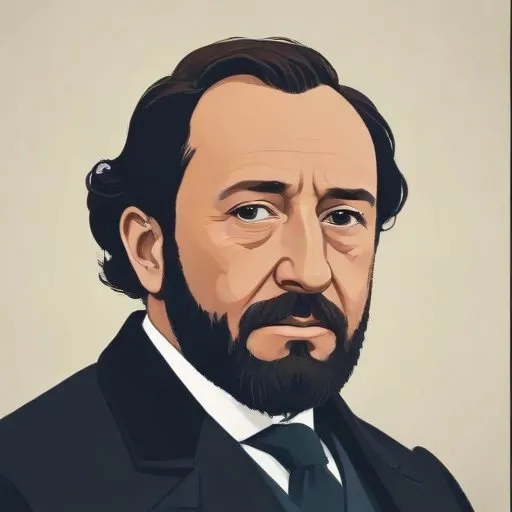
A French lawyer and politician who served as Prime Minister of France, known for implementing education reforms and expanding France's colonial empire.
Jules Ferry, born on April 5, 1832, in the Vosges department of France, was a statesman and republican philosopher who left an indelible mark on French history. He was one of the leaders of the Moderate Republicans and served as Prime Minister of France from 1880 to 1881 and 1883 to 1885.
Ferry's entry into politics was marked by his vocal opposition to the Second French Empire, which he criticized through his writings in various newspapers, including Le Temps. His scathing attacks on Baron Haussmann, prefect of the Seine department, were later compiled into a book titled The Fantastic Tales of Haussmann in 1868.
Elected as a republican deputy for Paris in 1869, Ferry protested against the declaration of war with Germany and was later appointed prefect of the Seine by the Government of National Defense on September 6, 1870. He played a crucial role in administering Paris during the siege and after the Paris Commune, but was forced to resign on June 5, 1871.
From 1872 to 1873, Ferry served as minister to Athens, sent by Adolphe Thiers. He returned to the chamber as deputy for the Vosges and emerged as one of the leaders of the Opportunist Republicans.
Ferry's most enduring legacy lies in his education reforms, which made primary education free and compulsory through several new laws. This move had far-reaching consequences, democratizing education and paving the way for France's emergence as a modern nation-state.
Ferry was a vocal proponent of colonial expansion, which he saw as essential for France's economic growth and global influence. During his tenure as Prime Minister, he oversaw the expansion of French colonial territories, including the conquest of Tunisia and the colonization of Indochina.
Ferry's political career was marred by controversy, particularly during the Sino-French War in 1885, when he was forced to resign due to unpopularity and public opinion against the war. Despite this, Ferry's contributions to French education and colonial expansion remain unparalleled, and his legacy continues to shape French society and politics to this day.
Ferry's philosophical contributions were shaped by his commitment to laicism and republicanism. He believed in the importance of separating church and state, and his education reforms were designed to promote secular values and critical thinking.
Ferry's influence on modern French society is profound. His education reforms have shaped the country's education system, while his colonial expansion policies have had lasting impacts on France's global influence and relationships with its former colonies.
Ferry's political career can be compared to that of his contemporaries, such as Léon Gambetta and Adolphe Thiers, who also played important roles in shaping modern France. However, Ferry's unique blend of laicism, republicanism, and colonial expansion sets him apart from his peers.
Ferry's life and career must be understood within the context of late 19th-century France, a period marked by rapid industrialization, urbanization, and colonial expansion. His legacy continues to shape French society and politics, and his influence can be seen in the country's ongoing debates about education, laicism, and colonialism.
Born in 1838
A French lawyer and politician who served as Prime Minister of France, known for his key role in the Franco-Prussian War and his efforts to modernize and unify France. He's a significant figure in French history, shaping the country's politics and identity.
Born in 1851
A French field marshal who played a crucial role in World War I, leading the Allied forces to victory and earning the title "The Tiger" for his tenacity and strategic genius. He's also known for his post-war efforts to maintain peace and stability in Europe.
Born in 1841
A French journalist, physician, and politician who served as Prime Minister of France during World War I, leading the country to victory and playing a key role in shaping the Treaty of Versailles. He's also known for his strong leadership and witty humor.
Born in 1860
A French statesman who served as President of France during a tumultuous period, playing a crucial role in shaping the country's response to World War I. He's also known for his efforts to reform the French economy and stabilize the franc.
Born in 1862
A French statesman who served as Prime Minister of France and was awarded the Nobel Peace Prize for his efforts to establish the European unity and collective security. He played a key role in shaping the League of Nations and promoting international cooperation.
Born in 1872
A French lawyer and politician who served as Prime Minister of France, known for his efforts to rebuild the country after World War I and his advocacy for European unity.
Born in 1863
A French mathematician and politician who served as Prime Minister of France, making significant contributions to mathematics, particularly in the field of differential equations. He's also known for his role in shaping France's early 20th-century politics.
