


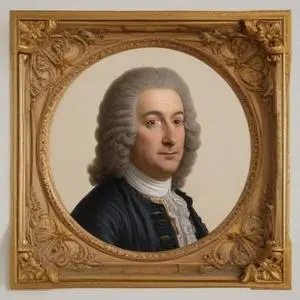
A prominent French architect of the 17th century, renowned for designing grandiose Baroque buildings, including the Palace of Versailles. His work epitomized the opulence and extravagance of the French monarchy.
Jules Hardouin-Mansart was a French Baroque architect and builder, renowned for his monumental works that glorified the reign of Louis XIV of France. His majestic creations, including the Place des Victoires, Place Vendôme, and the Grand Trianon of the Palace of Versailles, continue to awe and inspire architects, historians, and enthusiasts alike.
Born in Paris on April 16, 1646, Hardouin-Mansart was destined for greatness. He studied under his great-uncle, the celebrated architect Franois Mansart, one of the pioneers of the classical tradition in French architecture. In 1668, Hardouin-Mansart inherited his great-uncle's collection of plans and drawings, and added Mansart's name to his own.
Hardouin-Mansart began his career as an entrepreneur in building construction, partnering with his brother Michel. However, he soon decided to devote himself entirely to architecture, and in 1674, became one of the group of royal architects working for Louis XIV. His first major project was the Château de Clagny, built for the King's consort, Madame de Montespan.
Hardouin-Mansart's exceptional talent, combined with his mastery of bureaucratic diplomacy, earned him the protection and support of Madame de Montespan, and later, François-Michel le Tellier, Marquis de Louvois, the Minister of War. He collaborated with landscape designer André Le Nôtre, before working directly with the King himself.
Hardouin-Mansart's work was not limited to these iconic structures. He also worked on the expansion of the Palace of Versailles, a project that occupied him for the rest of his life. He became a member of the Académie royale d'architecture in 1678 and was named First Architect of the King in 1681. He was raised to the nobility in 1682 and became intendant of the King in 1685, and royal inspector-general of buildings in 1691.
Hardouin-Mansart's contributions to French architecture and urban planning have had a lasting impact on modern society. His designs inspired generations of architects, and his work continues to influence contemporary architecture and urban design.
Hardouin-Mansart's legacy extends beyond his architectural masterpieces. He played a significant role in shaping the aesthetic and cultural identity of France during its Golden Age. His work continues to inspire awe and admiration, cementing his place as one of the greatest architects in French history.
Jules Hardouin-Mansart passed away on May 11, 1708, leaving behind a legacy that continues to inspire and awe architects, historians, and enthusiasts alike. His monumental works remain a testament to his genius, creativity, and dedication to the art of architecture.
Born in 1710
The monarch who ruled France from 1715 to 1774, known as the "Sun King's" great-grandson, and remembered for his extravagance, absolutism, and the decline of the French monarchy.
Born in 1613
Designed majestic gardens and palaces for French monarchs, revolutionizing landscape architecture with his innovative and harmonious style.
Born in 1619
A dominant figure in 17th-century French art, he was a painter, art theorist, and director of the Gobelins Manufactory, creating grandiose and dramatic works that epitomized the French Baroque style. He wrote extensively on art theory, influencing generations of artists.
