


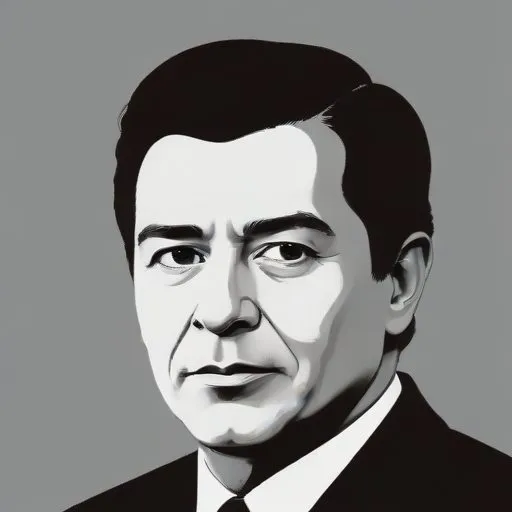
A Colombian lawyer and politician who served as the 25th President of Colombia, known for his efforts to establish peace and stability in the country during a tumultuous period. He implemented policies to combat drug trafficking and guerrilla warfare.
Julio César Turbay Ayala, the 25th President of Colombia, left an indelible mark on the country's political landscape from 1978 to 1982. He was a visionary leader, a shrewd diplomat, and a champion of democracy, known for his unwavering commitment to modernizing Colombia and strengthening its relationships with the international community.
Born on June 18, 1916, in Bogotá, Colombia, Turbay Ayala came from a family of Lebanese and Colombian descent. His father, Antonio Amín Turbay, was a successful businessman who had emigrated from Lebanon, while his mother, Rosaura Ayala, was a peasant from the province of Cundinamarca. Despite his family's financial setbacks during the Thousand Days War, Turbay Ayala's father instilled in him a strong work ethic and a passion for learning.
Although he never attended college, Turbay Ayala became an autodidact, driven by his insatiable curiosity and thirst for knowledge. This self-taught approach would later earn him numerous honorary degrees, a testament to his dedication to lifelong learning.
Turbay Ayala's political career began in 1936, when he was elected as a councilman in the town of Usme. He quickly rose through the ranks, becoming mayor of Girardot in 1937 and councilman in Engativ in 1938. His leadership skills and charisma earned him a seat in the Assembly of Cundinamarca, and later, in the Colombian Congress.
In 1953, he became a member of the national directive of the Liberal Party, where he played a key role in shaping the party's agenda and policies. Turbay Ayala's unwavering commitment to democracy and social justice earned him the respect and admiration of his peers, and he soon became a leader in the opposition to conservative governments.
In 1957, Turbay Ayala was appointed Minister of Mines and Petroleum by the military Junta that ousted dictator Gustavo Rojas Pinilla. This marked the beginning of his illustrious diplomatic career, which saw him serve as Minister of Foreign Affairs from 1961 to 1962, under President Alberto Lleras Camargo.
As Foreign Minister, Turbay Ayala played a crucial role in strengthening Colombia's relationships with the international community, particularly with the United States. He was appointed Ambassador to the United States in 1969, a position he held until 1972.
In 1978, Turbay Ayala was elected President of Colombia, a position he held until 1982. During his presidency, he implemented a range of reforms aimed at modernizing the country's economy, strengthening its institutions, and promoting social justice.
Turbay Ayala's presidency was marked by significant achievements, including the establishment of the National Registry of Civil Status, the creation of the Colombian Institute of Culture, and the adoption of a new constitution. He also played a key role in promoting regional integration, particularly through the Andean Pact.
Despite facing numerous challenges, including economic instability and guerrilla warfare, Turbay Ayala remained committed to his vision of a modern, democratic Colombia. His leadership and statesmanship earned him international recognition, and he remains one of the most respected and revered leaders in Colombian history.
Turbay Ayala passed away on September 13, 2005, leaving behind a legacy of public service, diplomatic acumen, and vision. His life's work serves as a testament to the power of dedication, perseverance, and commitment to the greater good.
In his later years, Turbay Ayala continued to be involved in public life, serving as a member of the Council of State and participating in various international forums and conferences. His wisdom, experience, and knowledge were sought by leaders and policymakers from around the world.
Turbay Ayala's impact on modern society extends far beyond his presidency. His commitment to democracy, social justice, and regional integration has inspired generations of Colombians and Latin Americans. His leadership has served as a model for politicians and policymakers, demonstrating the importance of vision, perseverance, and diplomatic acumen.
Today, Turbay Ayala's legacy continues to shape Colombia's development, informing policy decisions and guiding the country's relations with the international community. His life's work serves as a beacon of hope, inspiring future generations to strive for a more just, equitable, and peaceful world.
79 Years Old
The 36th President of Colombia, a key figure in the country's politics and economy, known for his efforts to reform the Colombian economy and tackle the drug trade. He also played a crucial role in the extradition of Pablo Escobar.
76 Years Old
The 29th President of Colombia, a key figure in the country's politics, known for his involvement in the country's peace process and accused of receiving campaign funds from the Cali cartel. He served from 1994 to 1998.
72 Years Old
The 38th President of Colombia, a lawyer and politician who led the country from 1998 to 2002, is most known for his efforts to bring peace to Colombia through negotiations with guerrilla groups and his role in the country's economic development.
74 Years Old
The 39th President of Colombia, a lawyer and politician, is known for his hardline stance against guerrilla groups and his efforts to strengthen the country's economy. He's also infamous for his alleged ties to paramilitary groups.
75 Years Old
The 59th President of Colombia, a Nobel Peace Prize winner, who led the country's peace process, ending a 52-year conflict with the FARC guerrilla group. He's known for his efforts to bring peace and stability to Colombia.
