


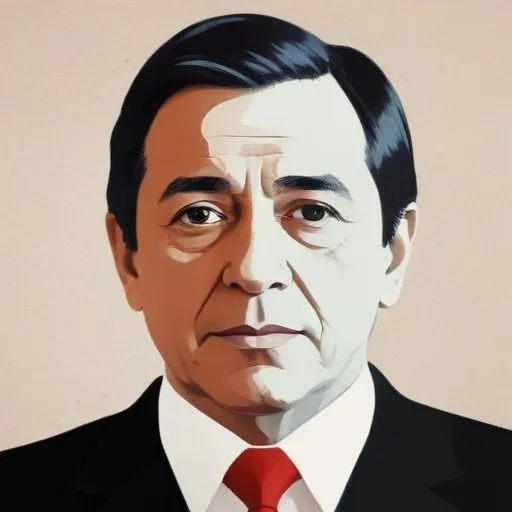
Argentine politician who served as Governor of Mendoza Province from 1963 to 1966 and was a prominent figure in the country's Radical Civic Union party. He's known for his efforts to modernize and develop the region's infrastructure.
Julio Antonio Miranda was a prominent Argentine politician and a stalwart member of the Justicialist Party, known for his remarkable tenure as Governor of Tucumán and his subsequent role as a Senator representing the same province. His remarkable political career, which spanned over three decades, was marked by his unwavering commitment to the welfare of his people and his unrelenting zeal for social justice.
Born on October 17, 1946, in the quaint village of Manuel García Fernández, Leales Department, Tucumán, Miranda's early life was characterized by humble beginnings. Despite completing only half of his elementary education, he possessed an innate ability to connect with the masses, which would eventually become the hallmark of his political career.
Miranda's entry into politics was facilitated by his role as a trade union man, representing the State Oil Workers Trade Union SUPE. This experience not only instilled in him a deep understanding of the struggles faced by the working class but also equipped him with the necessary skills to navigate the complex world of politics.
In 1992, Miranda's political fortunes took a significant turn when he was elected as a Senator by the Tucumán province legislature. This milestone marked the beginning of his meteoric rise to prominence in Argentine politics.
In 1999, Miranda's popularity and influence propelled him to the governorship of Tucumán, where he defeated the son of the incumbent governor, Antonio Domingo Bussi, by a narrow margin of 6,800 votes. His four-year tenure as governor was marked by controversy and fierce opposition from the Republican Force Tucumán party, led by Antonio Bussi and his son, Ricardo.
Despite the challenges he faced, Miranda's dedication to the people of Tucumán remained unwavering. His tenure as governor saw the implementation of several initiatives aimed at improving the lives of the people, including infrastructure development and social welfare programs.
In addition to his political achievements, Miranda also served as the President of the soccer club Club Atlético Tucumán from 1997 to 1999, a testament to his multifaceted personality and ability to connect with people from diverse backgrounds.
After completing his term as governor, Miranda returned to the Senate, where he continued to serve the people of Tucumán until his untimely demise on June 6, 2021, at the age of 74.
Today, Julio Miranda is remembered as a champion of the people, a politician who dedicated his life to serving the masses and fighting for their rights. His legacy continues to inspire generations of politicians and social activists, who draw strength from his unwavering commitment to social justice and his unrelenting zeal for the betterment of humanity.
Born in 1895
The authoritarian leader who ruled Argentina with his charismatic wife Eva, implementing populist economic policies and promoting nationalism, while suppressing opposition and civil liberties.
Born in 1919
A former actress who used her charisma and influence to advocate for women's suffrage and workers' rights, becoming a beloved and powerful figure in Argentine politics.
Born in 1908
Lawyer and politician who served as President of Argentina from 1958 to 1962, known for his efforts to modernize the country's economy and infrastructure. He also established diplomatic relations with the Soviet Union, a significant move during the Cold War era.
99 Years Old
The first democratically elected president of Argentina after a period of military rule, known for his efforts to promote human rights and democracy in the country.
96 Years Old
The 50th President of Argentina, a lawyer-turned-politician who implemented neoliberal economic policies and pardoned military officers involved in human rights abuses during the country's Dirty War. He's also known for his flamboyant style and corruption scandals.
89 Years Old
Led Argentina through a tumultuous period, implementing economic reforms and navigating corruption scandals, while also being a key figure in the country's transition to democracy. Known for his efforts to stabilize the economy and promote human rights.
76 Years Old
The 51st President of Argentina, who served from 2003 to 2007, is known for his efforts to rebuild the country's economy and restore its international reputation after a severe crisis. He's also recognized for his human rights advocacy and social welfare programs.
73 Years Old
The first female President of Argentina, serving from 2007 to 2015, known for her progressive policies and strong leadership during a period of economic growth. She later became Vice President, continuing to shape the country's politics.
