


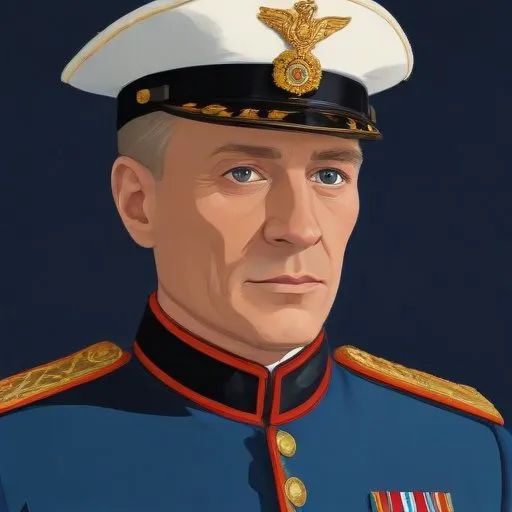
An Estonian educator and lieutenant who played a key role in the country's War of Independence, leading a student battalion to several victories against the Bolsheviks. He's also known for his contributions to Estonian education and scouting.
Julius Kuperjanov is a renowned Estonian military officer, best known for being one of the Liberators of Tartu during the War of Independence and commander of the Tartumaa Partisan Battalion, renamed after him posthumously.
Kuperjanov was born on October 11, 1894, to Taniel and Liisi Kuperjanov (née Reben), a family of Estonian immigrants living in Pskov, Russia. His family returned to Estonia in 1904 and resided in Tartu county. After completing his studies at the Tartu Teachers Seminar in 1914, he became a teacher at the village school in Kambja.
At the start of World War I, Kuperjanov was mobilized into the Imperial Russian Army and commissioned after receiving basic training at Vladamir Military School in Saint Petersburg. He was wounded in both legs in July 1917. In 1917, he joined the Estonian forces during the start of the War of Independence.
In December 1918, Kuperjanov received permission to form a ranger battalion, which would later become the Tartumaa Partisan Battalion. His bravery and tactical prowess played a crucial role in the liberation of Tartu. On January 5, 1919, he led the liberation of the first village in Southern Estonia, Sadukla, followed by the liberation of Tartu on January 13, 1919.
Kuperjanov married Alice Johanson on February 26, 1918. His personal life was marked by his dedication to his country and his people, which ultimately led to his tragic demise on February 2, 1919.
Julius Kuperjanov's heroism and selflessness have made him a national hero in Estonia. The Tartumaa Partisan Battalion was renamed after him posthumously, and his bravery continues to inspire generations of Estonians. His legacy serves as a reminder of the importance of courage, patriotism, and sacrifice for the greater good.
Kuperjanov's contributions to Estonia's struggle for independence have left an indelible mark on the country's history. His bravery and leadership have inspired countless Estonians to stand up for their rights and fight for their freedom.
Julius Kuperjanov's story is a testament to the power of courage, dedication, and sacrifice. His legacy continues to inspire and motivate people to this day, serving as a reminder of the importance of standing up for what is right and fighting for one's country.
Born in 1874
Estonia's first president, a key figure in the country's struggle for independence from Russia, served as a unifying force during tumultuous times. He's remembered for his role in shaping Estonia's early years and its path to sovereignty.
Born in 1884
A prominent military leader who played a crucial role in Estonia's struggle for independence, leading the country's armed forces to victory in the Estonian War of Independence.
Born in 1884
Estonia's 7th Prime Minister, a lawyer and politician who played a crucial role in shaping the country's early years of independence, known for his diplomatic efforts and national unification.
Born in 1888
Estonian journalist and politician who served as the 6th Prime Minister of Estonia, known for his leadership during the country's interwar period and his role in shaping the nation's early years of independence.
Born in 1872
Estonia's 7th State Elder, a prominent lawyer and politician, played a crucial role in shaping the country's early 20th-century government and politics. He's most known for his efforts in establishing Estonia's independence and sovereignty.
Born in 1886
Estonia's Head of State during World War II, leading the country's government-in-exile and advocating for independence from Soviet occupation. He played a crucial role in preserving Estonia's sovereignty and identity.
Born in 1871
Estonian physician and politician who served as the Head of State of Estonia, playing a crucial role in the country's struggle for independence. He is remembered for his efforts to establish a sovereign Estonian state.
Born in 1885
Head of State of Estonia during the country's struggle for independence, known for leading the Estonian Provisional Government in 1918-1919.
