


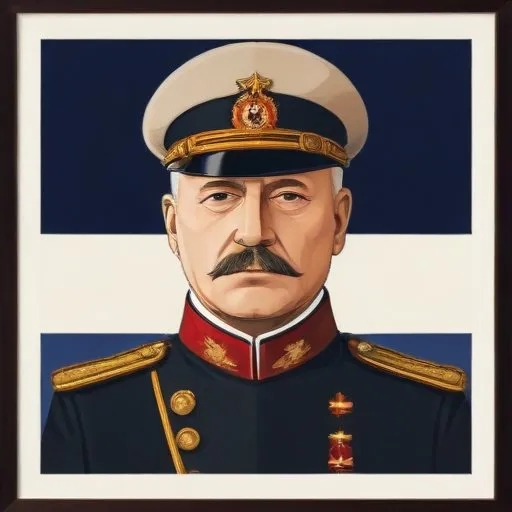
A prominent military leader who played a crucial role in Estonia's struggle for independence, leading the country's armed forces to victory in the Estonian War of Independence.
Johan Laidoner, a renowned Estonian general and statesman, is predominantly known for his role as the Commander-in-Chief of the Estonian Armed Forces during the 1918-1920 Estonian War of Independence and his significant influence on Estonian politics between the two world wars.
Born on February 12, 1884 (O.S. January 31), in Viiratsi, Kreis Fellin, Governorate of Livonia, Laidoner hailed from a humble background, with his parents, Jaak Laidoner and Mari nee Saarsen, being farmhands. Despite the financial constraints, Laidoner's parents encouraged his education, and he studied at Viiratsi Elementary School and later at Viljandi Town School, graduating in 1900.
Faced with limited opportunities for further education, Laidoner voluntarily joined the Imperial Russian Army in 1901. He served in the 110th Kama Infantry Regiment, based in Kovno (now Kaunas, Lithuania), before being sent to study at the Infantry Officer School in Vilna (Vilnius) from 1902 to 1905. Laidoner's exceptional academic performance earned him top honors in his class, and he was promoted to the rank of sublieutenant in April 1905.
Laidoner's military career advanced rapidly, with him serving in various positions within the 13th Yerevan Grenadier Regiment, stationed in Manglisi, Georgia. Following the Russian Revolution in 1917, he commanded the Estonian national units of the Russian army. In 1918, the Estonian Provisional Government appointed him Commander-in-Chief of the armed forces of the newly independent Republic of Estonia.
During the Estonian War of Independence, Laidoner played a pivotal role in securing the country's freedom, and his leadership was instrumental in the eventual victory. After the war, he served as a member of the parliament (Riigikogu) from 1920 to 1929, and twice again as Commander-in-Chief, first during the 1924 Communist coup attempt and then from 1934 to 1940.
In 1940, following the Soviet occupation of Estonia, Laidoner was arrested and deported to Russia, where he was imprisoned until his death on March 13, 1953. Despite his untimely demise, Laidoner's contributions to Estonia's independence and his role in shaping the country's politics are still revered today.
Laidoner's life and career are inextricably linked to the tumultuous period of Estonian history, marked by the struggle for independence and the subsequent Soviet occupation. His leadership during the Estonian War of Independence and his influence on Estonian politics demonstrate his unwavering commitment to his country's sovereignty.
In the context of Estonian history, Laidoner's legacy is multifaceted. He is remembered as a skilled military strategist, a devoted statesman, and a champion of Estonian independence. His contributions have left an indelible mark on the country's development, and his name remains synonymous with courage, patriotism, and leadership.
In conclusion, Johan Laidoner's remarkable life andcareer serve as a testament to his unwavering dedication to Estonia's independence and his unrelenting pursuit of excellence. His legacy continues to inspire generations, cementing his place as one of the most influential figures in Estonian history.
Born in 1874
Estonia's first president, a key figure in the country's struggle for independence from Russia, served as a unifying force during tumultuous times. He's remembered for his role in shaping Estonia's early years and its path to sovereignty.
Born in 1868
Estonia's 2nd Prime Minister, a pioneering journalist, lawyer, and politician who played a crucial role in the country's struggle for independence and development. He's most known for his efforts to establish a democratic government and promote national unity.
Born in 1884
Estonia's 7th Prime Minister, a lawyer and politician who played a crucial role in shaping the country's early years of independence, known for his diplomatic efforts and national unification.
Born in 1888
Estonian journalist and politician who served as the 6th Prime Minister of Estonia, known for his leadership during the country's interwar period and his role in shaping the nation's early years of independence.
Born in 1886
Estonia's Head of State during World War II, leading the country's government-in-exile and advocating for independence from Soviet occupation. He played a crucial role in preserving Estonia's sovereignty and identity.
Born in 1890
A prominent Estonian leader who served as the country's Prime Minister during a tumultuous period, guiding Estonia through World War II and the Soviet occupation. He's revered for his bravery and statesmanship during Estonia's struggle for independence.
Born in 1890
Leader of Estonia's government-in-exile during World War II, fighting for independence from Soviet occupation. Known for his efforts to preserve Estonian sovereignty and culture.
Born in 1889
Estonia's first Prime Minister after declaring independence from Russia, leading the country through its early years of statehood. He played a crucial role in shaping Estonia's government and constitution.
