


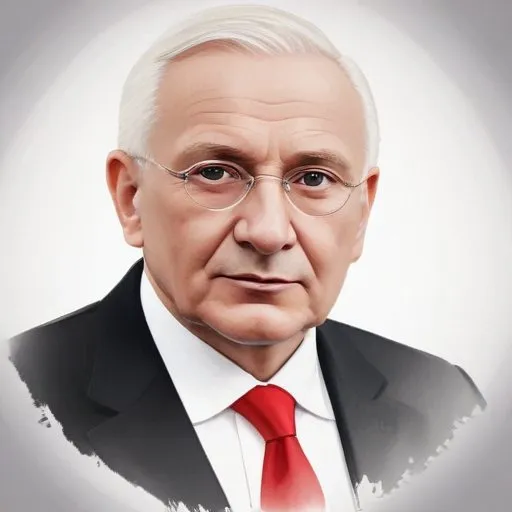
A Polish economist and politician who served as the 7th Prime Minister of Poland, known for his role in the country's transition from communism to capitalism. He was a key figure in shaping Poland's economic and political landscape in the 1990s.
Oleksy was born on June 22, 1946, in Nowy Sącz, Poland. He grew up in a modest family and was an altar boy at St. Margaret's Church. He graduated from Kazimierz Brodzinski High School in Tarnów and later obtained a doctoral degree in economics from the Warsaw School of Planning and Statistics (now SGH Warsaw School of Economics).
Oleksy's political career spanned over three decades, during which he held various positions in the Communist Party and later in the Democratic Left Alliance. From 1968 to 1990, he was a member of the Polish United Workers' Party (PZPR) and served as the secretary of the PZPR University Committee at the Warsaw School of Planning and Statistics. In the 1980s, he worked in the party apparatus and was the First Secretary of the Provincial Party Committee in Biała Podlaska.
In 1989, Oleksy represented the Communist leadership in the round table talks with the opposition Solidarity movement, a historic event that paved the way for Poland's transition to democracy. He was one of the founders of the Social Democracy of the Republic of Poland in 1990 and served as the chairman of the party from 1996 to 1997.
Oleksy became the Prime Minister of Poland on March 7, 1995, but his tenure was short-lived. He resigned on February 7, 1996, amidst allegations of espionage and collaboration with the Soviet Union. The scandal led to a significant crisis in Polish politics and ultimately resulted in the downfall of the Democratic Left Alliance.
Oleksy's political legacy is marred by controversies and scandals. His alleged involvement in espionage and his role in the Communist regime have been the subject of much debate and criticism. Despite this, he remains a significant figure in Polish politics, known for his charisma and leadership skills.
Oleksy was a lecturer at the Faculty of International Relations at the SGH Warsaw School of Economics and the Vistula University in Warsaw. He was also a dean at the Faculty of International Relations. Apart from his political career, Oleksy was known for his academic pursuits and was a respected figure in the field of economics.
Oleksy's political career had a significant impact on modern Polish society. His role in the round table talks and his leadership in the Democratic Left Alliance contributed to the country's transition to democracy. Despite the controversies surrounding his resignation, Oleksy remains an important figure in Polish politics and history.
Oleksy was a staunch supporter of socialism and democracy. He believed in the importance of social justice and equality, and his political career was driven by a desire to improve the lives of ordinary Poles. His philosophical contributions to Polish politics are still studied and debated by scholars today.
71 Years Old
The 3rd President of Poland, a journalist-turned-politician who played a key role in Poland's transition from communism to democracy, and is known for his efforts to join NATO and the EU.
83 Years Old
A Polish electrician-turned-politician who played a key role in the country's transition from communism to democracy, and was awarded the Nobel Peace Prize for his efforts. He's a symbol of resistance against oppression and a champion of workers' rights.
80 Years Old
A Polish politician who served as Prime Minister from 2001 to 2004, known for his left-wing policies and efforts to join the European Union.
76 Years Old
The 8th Prime Minister of Poland, a lawyer-turned-politician who led the country's government in the 1990s, known for his efforts to reform the economy and strengthen Poland's ties with the European Union.
66 Years Old
A Polish physicist and politician who served as Prime Minister of Poland, known for his contributions to quantum field theory and leading the country's government.
77 Years Old
A Polish lawyer and politician who served as Prime Minister of Poland, known for his conservative policies and close relationship with his twin brother, also a prominent politician. He played a significant role in shaping Poland's political landscape.
69 Years Old
The 14th Prime Minister of Poland, a journalist-turned-politician who played a key role in shaping the country's post-communist era and later became a prominent EU leader. He's known for his strong stance on European integration and criticism of authoritarianism.
69 Years Old
The first female Prime Minister of Poland, serving from 2014 to 2015, known for her efforts to strengthen the country's economy and healthcare system.
