


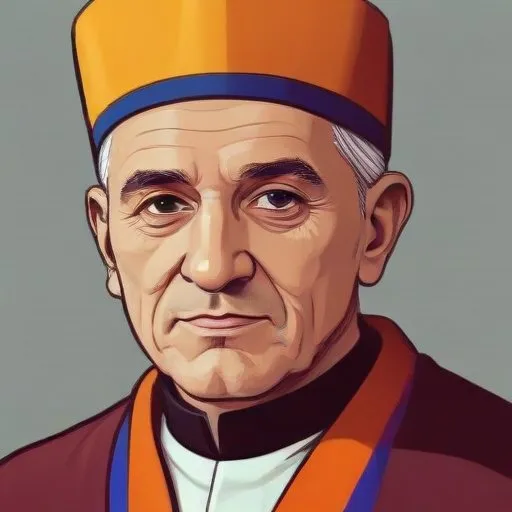
A Slovene-Hungarian priest and politician who played a key role in the Slovene national revival and advocated for Slovene autonomy within the Austro-Hungarian Empire. He's remembered for his efforts to promote Slovene language and culture.
Jzsef Klekl, a Slovene Roman Catholic priest and politician, is renowned for his tireless efforts in promoting the independence of the Slovene March in Hungary and his contributions to the Slovene Peoples Party. As a prolific writer and governor of the Slovene Peoples Party, Klekl's works and ideologies continue to inspire and influence Slovenian politics to this day.
Born on October 13, 1874, in Prekmurje, Krajna, in the Vas County of the Kingdom of Hungary, Klekl was raised in a family of German descent. His parents, Istvn Klekl and Terz Slmn, were farmers, and his grandfather Anton Klekl was born in Kellerdorf, near Radkersburg, Austria.
On July 11, 1897, Klekl became a priest and chaplain to Ferenc Ivanczy in Tiina, working closely with Ivanczy, the governor of the Hungarian Slovenes. He later served as a chaplain in Drnbach im Burgenland (1902-1903) and renovci (1903-1905) before becoming the priest in Pearovci in 1905.
In 1904, Klekl founded the Hungarian Slovene Catholic newspaper Marijin liszt, which became a platform for him to express his views on Slovenian independence. He later founded the semiradical newspaper Novine in 1914, where he vehemently opposed the Hungarisation of Prekmurje.
In 1918, as the Austro-Hungarian Empire was on the brink of collapse, Klekl worked closely with Slovene politician Anton Koroec and other prominent figures, including Jzsef Szakovics, Ivn Bassa, Istvn Khr, and Jzsef Csrics, to develop the Slovene March programme. Although their efforts were met with resistance from the Bolshevik administration and Serbian forces, who eventually annexed Prekmurje, Klekl's contributions to the Slovene independence movement remain unparalleled.
Klekl's selfless dedication to the Slovenian cause and his written works continue to inspire generations of Slovenian politicians and scholars. His legacy serves as a testament to the power of perseverance and vision in the face of adversity.
Through his remarkable life and work, Jzsef Klekl has left an indelible mark on Slovenian history, and his contributions will continue to shape the country's politics and identity for years to come.
Born in 1868
Led a right-wing authoritarian government in Hungary between the two World Wars, known for his anti-Semitic and nationalist policies. He collaborated with Nazi Germany during World War II.
Born in 1803
A Hungarian statesman who played a key role in the country's unification with Austria, creating the dual monarchy of Austria-Hungary in 1867. He's known for his efforts to establish a constitutional government and promote national unity.
Born in 1823
This Hungarian poet and activist was a key figure in the country's struggle for independence and is celebrated for his passionate and patriotic verses, which inspired a nation. He's often considered the national poet of Hungary.
Born in 1802
A key figure in the Hungarian Revolution of 1848, leading the fight for independence from Austria and becoming a symbol of Hungarian nationalism. He's revered for his passionate oratory skills and unwavering dedication to his country's freedom.
