


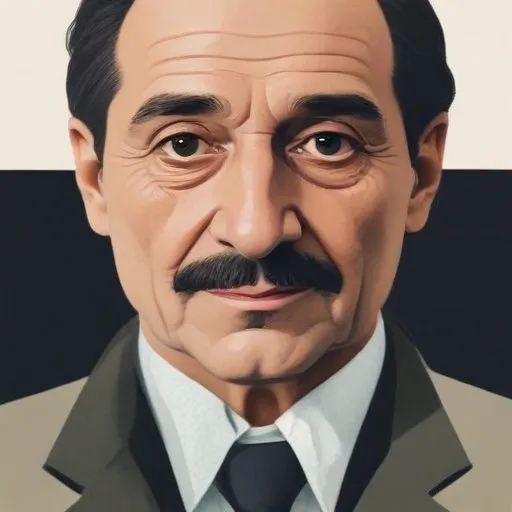
A Slovene-Hungarian poet and journalist who wrote about social and national issues, and was a key figure in the Slovene literary movement. He's known for his lyrical poetry and essays that explored the human condition.
Jzsef Pusztai, also known as Tibor Andorhegyi, was a renowned Slovene writer, poet, journalist, teacher, and cantor who made significant contributions to the cultural heritage of Hungary and Slovenia. Born on January 26, 1864, in Bellatincz, Muravidk, Kingdom of Hungary (present-day Beltinci, Prekmurje, Slovenia), Pusztai is best known for his literary works that promoted Hungarian-Slovene cultural understanding and assimilation.
Pusztai's parents, Jnos Pozderecz and Franciska Nemecz, instilled in him a strong sense of cultural identity, which would later shape his writing and teaching career. He studied to be a teacher in Csktornya (present-day akovec, Croatia) and Pcs, graduating in 1883. After a brief stint in Szce, he returned to Muravidk in 1889, where he would spend the next three decades of his life.
Pusztai's literary works were instrumental in promoting Hungarian-Slovene cultural understanding. His most notable work is the Krcsnszko katholicsanszko pesmi z iz potrejbnimi molitvami i vngimi vogrszkimi peszmami, a Catholic hymnal written in both Prekmurje Slovene and Hungarian. This pioneering work was the first of its kind in the region and paved the way for greater cultural exchange.
In addition to his hymnal, Pusztai wrote articles for various publications, including Muraszombat s Vidke (Murska Sobota and District) and rtest in Szombathely. His contributions to the literary world were further recognized through his publication of Dober pajds (Good Friend) in Szentgotthrd, a magazine that promoted cultural understanding and friendship between Hungarians and Slovenes.
Pusztai's teaching career spanned over three decades, during which he worked tirelessly to promote cultural understanding and education in Muravidk. He taught in Mrtonhely, near Muraszombat (present-day Martjanci, near Murska Sobota), where he wrote the first hymnal in Prekmurje Slovene.
Jzsef Pusztai's legacy is one of cultural understanding and assimilation. Through his literary works and teaching career, he bridged the gap between Hungarian and Slovene cultures, promoting greater understanding and cooperation between the two communities. His contributions to the cultural heritage of both Hungary and Slovenia are still celebrated today, making him a revered figure in the region's literary history.
In 1919, Pusztai returned to his hometown of Beltinci, where he spent the remainder of his life. He passed away on February 13, 1934, leaving behind a legacy of cultural understanding and literary excellence.
Born in 1790
A Hungarian poet, critic, and politician who played a key role in shaping the country's literary and cultural identity, and is best known for writing the lyrics to the Hungarian national anthem.
Born in 1803
A Hungarian statesman who played a key role in the country's unification with Austria, creating the dual monarchy of Austria-Hungary in 1867. He's known for his efforts to establish a constitutional government and promote national unity.
Born in 1802
A key figure in the Hungarian Revolution of 1848, leading the fight for independence from Austria and becoming a symbol of Hungarian nationalism. He's revered for his passionate oratory skills and unwavering dedication to his country's freedom.
