


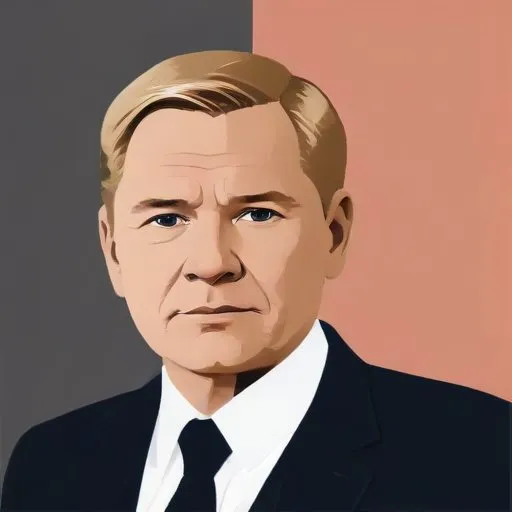
Finnish politician who served as the Minister of Justice from 1926 to 1927 and played a key role in shaping Finland's early 20th-century political landscape.
Kalle Hakala was a Finnish newspaper editor, politician, and member of the Parliament of Finland, known for his unwavering dedication to the Social Democratic Party (SDP) and his unrelenting fight for the rights of the working class. Throughout his political career, Hakala played a significant role in shaping the Finnish political landscape, leaving an indelible mark on the country's history.
Born on March 18, 1880, in Lempl, Grand Duchy of Finland, Hakala was the son of farmworker Juha Hakala and Wilhelmina Myllymki. Before entering politics, he worked as a machinist from 1897 to 1907 and later became the editor of the Vapaus newspaper in Mikkeli from 1907 to 1918.
Hakala's foray into politics began in 1911 when he was elected to the Parliament of Finland, a position he held until 1918. During the Finnish Civil War, he was elected to the Central Workers' Council of Finland, the legislature of the Finnish Socialist Workers' Republic, and served as the secretary of the revolutionary government's agriculture department.
In the aftermath of the war, Hakala was arrested and sentenced to eight years in prison for treason and high treason. He lost his civic rights for ten years, a testament to the challenges he faced as a pioneer of the SDP.
Despite the setbacks, Hakala's legacy as a champion of social democracy and workers' rights continues to inspire generations of Finnish politicians. He was a vocal advocate for the rights of the working class, and his unwavering commitment to social justice paved the way for future generations of Finnish politicians.
Although Hakala's life was marked by turmoil and adversity, his contributions to Finnish politics have been recognized and celebrated. Today, he is remembered as a pioneering figure in the history of Finnish social democracy, a testament to the power of perseverance and dedication.
As we reflect on Hakala's life and legacy, we are reminded of the enduring power of social democracy and the importance of standing up for what is right, even in the face of adversity. His story serves as an inspiration to us all, a beacon of hope in the face of uncertainty.
Born in 1870
A Finnish statesman who played a crucial role in shaping Finland's post-WWII foreign policy and maintaining the country's independence during the Cold War era. He's known for his pragmatic and diplomatic approach to politics.
Born in 1900
A Finnish leader who served as President from 1956 to 1982, known for maintaining Finland's neutrality during the Cold War and fostering good relations with the Soviet Union.
Born in 1889
A Finnish lawyer and politician who served as the Governor of the Bank of Finland and the 5th President of Finland, known for leading the country through World War II. He played a crucial role in maintaining Finland's independence and sovereignty during the war.
Born in 1901
A Finnish politician who served as the Speaker of the Parliament and Prime Minister of Finland, known for his leadership during post-WWII reconstruction and social reform. He played a key role in shaping Finland's modern political landscape.
