


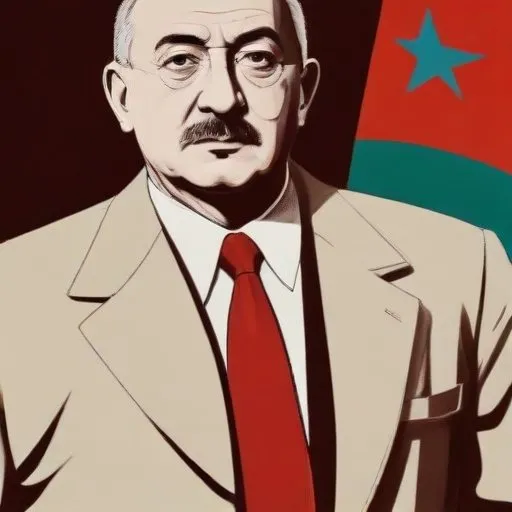
Led the Azerbaijan Communist Party during the Soviet era, implementing policies that shaped the country's economy and politics. He played a crucial role in Azerbaijan's development during a pivotal period.
Kamran Baghirov, a name synonymous with controversy, served as the 12th First Secretary of the Azerbaijan Communist Party from 1982 to 1988. During his tenure, he oversaw a tumultuous period marked by economic deterioration, widespread corruption, and the infamous Nagorno-Karabakh conflict.
Born on January 24, 1933, Baghirov's life was deeply entrenched in politics from an early age. He rose through the ranks of the Communist Party, eventually becoming the First Secretary of the Central Committee of the Communist Party of Azerbaijan SSR on December 3, 1982.
Baghirov's tenure was marred by allegations of corruption and economic mismanagement. He was criticized for his inability to prevent the exodus of ethnic Azerbaijanis from Armenia and Nagorno-Karabakh, and his passiveness in addressing the escalating conflict. The economic boom of Azerbaijan, which had flourished under his predecessor Heydar Aliyev, began to deteriorate under Baghirov's leadership.
One of the most significant criticisms leveled against Baghirov was his role in allowing the Nagorno-Karabakh Autonomous Oblast to fall under the direct rule of Moscow. This move was seen as a major failure of his leadership, and contributed to his eventual ousting from power.
In 1988, amidst growing discontent and criticism, Baghirov was replaced by Abdurrahman Vazirov as the First Secretary of the Communist Party. His removal from office marked the end of an era, and paved the way for a new generation of leadership in Azerbaijan.
Little is known about Baghirov's personal life, beyond his involvement in politics. He passed away on October 25, 2000, leaving behind a legacy of controversy and debate.
Baghirov's tenure as First Secretary of the Communist Party of Azerbaijan SSR occurred during a tumultuous period in the country's history. His leadership was marked by significant challenges, including the Nagorno-Karabakh conflict and economic decline. While his legacy is marked by controversy, it also serves as a reminder of the complex and often fraught nature of politics in Azerbaijan during the late 20th century.
Baghirov's leadership style and policies are often compared to those of his predecessor, Heydar Aliyev. While Aliyev was known for his strong leadership and economic acumen, Baghirov's tenure was marked by controversy and economic decline. This comparative analysis serves as a reminder of the significant impact that individual leaders can have on the trajectory of a nation.
Kamran Baghirov's life and legacy serve as a reminder of the complex and often controversial nature of politics in Azerbaijan during the late 20th century. While his leadership was marked by significant challenges and failures, it also highlights the importance of strong leadership and economic management in shaping the trajectory of a nation.
Born in 1923
Azerbaijan's leader who ruled with an iron fist, modernizing the country while suppressing opposition, leaving a lasting legacy in the region.
Born in 1870
Founder of the world's first socialist state, leading the Bolshevik Revolution and establishing the Soviet Union, known for his radical Marxist ideology and authoritarian rule.
Born in 1878
The Soviet Union's ruthless leader who ruled with an iron fist, implementing policies that led to widespread famine and purges, while also playing a crucial role in defeating Nazi Germany in World War II.
95 Years Old
The last leader of the Soviet Union, who introduced reforms that led to the end of the Cold War and the collapse of communism, earning a Nobel Peace Prize. He's known for his policies of glasnost and perestroika, which transformed the Soviet Union and the world.
Born in 1903
A Ukrainian engineer and politician who served as the Chairman of the Presidium of the Supreme Soviet, playing a key role in Soviet politics during the 1960s and 1970s.
Born in 1909
Soviet Minister of Foreign Affairs who played a crucial role in shaping the country's foreign policy during the Cold War, known for his diplomatic skills and ability to navigate complex international relations.
Born in 1906
A Soviet leader who ruled with an iron fist, implementing policies that stagnated the economy and suppressed dissent, while also being a key figure in the Cold War. He's infamous for his authoritarian regime and bureaucratic inefficiency.
Born in 1911
The last Soviet leader before Mikhail Gorbachev, he briefly ruled the USSR from 1984 to 1985, maintaining a hardline communist stance and resisting reform.
