


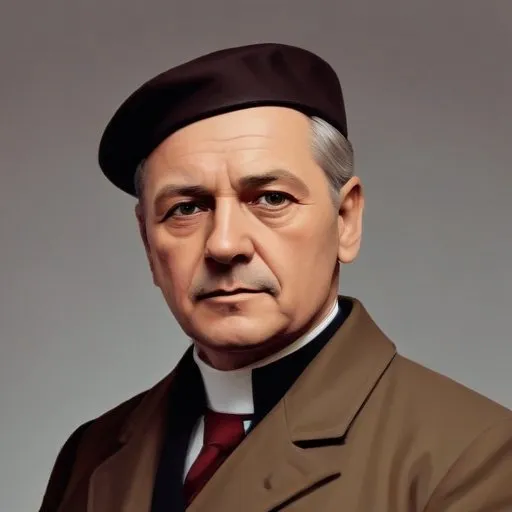
A Nazi doctor who performed inhumane medical experiments on concentration camp prisoners, particularly women and children, during World War II.
Karl Gebhardt, a Nazi physician and war criminal, is infamous for coordinating a series of gruesome medical atrocities in concentration camps during World War II. His heinous experiments on inmates at Ravensbrück and Auschwitz, aimed at justifying his approach to wound management, horrified the world and led to his conviction of war crimes and crimes against humanity.
Born on November 23, 1897, in Haag, Bavaria, Germany, Gebhardt was an active supporter of the national counterrevolutionary movement during his student days. He studied medicine at the University of Munich, where he received his degree in 1924. Under the tutelage of renowned surgeons Ferdinand Sauerbruch and Erich Lexer, Gebhardt honed his skills and eventually gained his habilitation in 1932.
Gebhardt's distinguished career in sports medicine led to his appointment as associate professor in Berlin in 1935. That same year, he joined the Nationalsozialistische Deutsche Arbeiterpartei (NSDAP), commonly known as the Nazi Party, on May 1. His membership marked the beginning of his involvement in the party's atrocities, which would eventually lead to his downfall.
As the main coordinator of medical experiments in concentration camps, Gebhardt oversaw the infliction of severe wounds, amputations, and forced surgeries on prisoners. He claimed these experiments were necessary to develop new surgical techniques, but in reality, they were intended to justify his approach to wound management in the face of emerging antibiotic treatments. The atrocities committed under his supervision are a dark stain on the history of medicine and humanity.
During the Subsequent Nuremberg Trials, Gebhardt stood trial in the "Doctors' Trial" (American Military Tribunal No. I). On August 20, 1947, he was convicted of war crimes and crimes against humanity, and subsequently sentenced to death. Gebhardt was hanged on June 2, 1948, in Landsberg Prison, Bavaria, Germany.
Karl Gebhardt's crimes serve as a chilling reminder of the dangers of unchecked power and the importance of upholding ethical standards in medicine. His legacy is a somber warning to future generations of the devastating consequences of allowing ideology to supplant humanity.
Born in 1900
Leading the SS and Gestapo, he oversaw the Nazi regime's brutal security apparatus and implemented the "Final Solution," orchestrating the genocide of six million Jews during World War II.
Born in 1889
The dictator of Nazi Germany, responsible for the genocide of six million Jews and millions of other people during World War II, and infamous for his extreme nationalist and anti-Semitic ideology.
Born in 1893
A high-ranking Nazi official, he was a decorated World War I fighter pilot and later became a prominent politician, serving as Minister President of Prussia. He's infamous for his role in the Nazi regime and war crimes trials.
Born in 1897
A mastermind of Nazi propaganda, he crafted a persuasive narrative that fueled the Third Reich's rise to power, leaving a lasting impact on the world.
Born in 1894
A high-ranking Nazi official who flew to Scotland on a solo mission to negotiate peace with the UK, but was instead arrested and imprisoned.
Born in 1893
A German diplomat who served as the Nazi regime's Foreign Minister, orchestrating key alliances and treaties that led to World War II. He was a close associate of Adolf Hitler and played a crucial role in shaping Nazi foreign policy.
Born in 1876
A German naval leader who played a key role in the Kriegsmarine during World War II, overseeing the German U-boat fleet and naval operations. He was a close advisor to Adolf Hitler and implemented the German naval strategy during the war.
Born in 1891
A German naval commander who led the U-boat fleet during World War II and briefly served as President of Germany after Hitler's death, known for his role in the war and its aftermath.
