


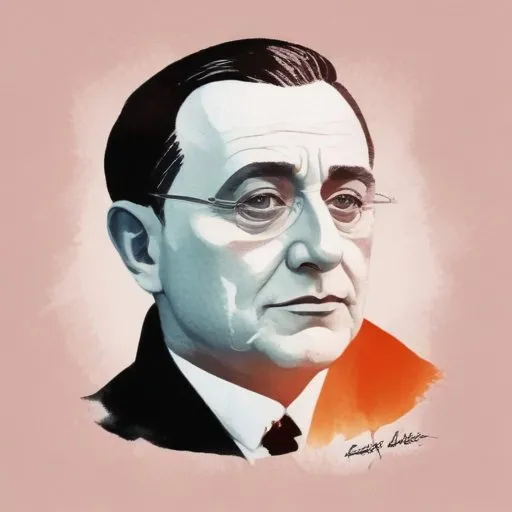
A 20th-century philosopher who explored the intersection of philosophy, history, and culture, known for his critiques of modernity and the concept of "worldliness".
Karl Löwith, a German philosopher, is renowned for his profound contributions to the phenomenological tradition, particularly through his influential works, From Hegel to Nietzsche and Meaning in History. These seminal books not only cemented his reputation as a leading thinker but also challenged the modern, secular progressive narrative of history, seeking to ground the meaning of history in itself.
Born on January 9, 1897, in Munich, Germany, to a Christian family of Jewish descent, Löwith's life was marked by significant events that shaped his philosophical outlook. He was trained in phenomenology under the tutelage of Edmund Husserl and Martin Heidegger, with whom he developed a close friendship. However, this relationship became estranged when Heidegger affiliated with Nazism, prompting Löwith to emigrate from Germany in 1934.
Löwith's journey took him to Italy and subsequently to Japan, where he lectured at Tohoku University, which had its own tradition of phenomenology. However, due to the alliance between the Third Reich and Japan, he had to leave Japan in 1941 and eventually made his way to the United States.
From 1941 to 1952, Löwith taught at the Hartford Theological Seminary and The New School for Social Research. In 1952, he returned to Germany to teach as a professor of philosophy at Heidelberg University, where he spent the remainder of his academic career until his passing on May 26, 1973.
Löwith's work was deeply influenced by the philosophical giants of his time, including Heidegger, Hegel, Nietzsche, and Kierkegaard. His writing after World War II can be seen as a response to the crisis of faith in the modern era, alongside other Christian philosophers and theologians of the 20th century, such as Karl Barth, Florovsky, and Erich Przywara.
Through his works, Löwith attempted to articulate an understanding of Christian faith in response to the challenges of scientism, secularism, and skepticism, demonstrating his commitment to the pursuit of meaning and truth.
Karl Löwith's philosophical contributions have left an indelible mark on the intellectual landscape of the 20th century. His critiques of modernity and his quest for meaning in history continue to inspire and challenge scholars, theologians, and philosophers today.
Through his life and works, Löwith embodied the spirit of intellectual curiosity and the pursuit of truth, leaving behind a rich legacy that will continue to illuminate the path for generations to come.
Born in 1889
A German philosopher and academic who explored the meaning of existence, time, and human existence, influencing 20th-century philosophy with his concept of "Being-in-the-world".
Born in 1906
A 20th-century philosopher and theorist who explored the nature of power, politics, and humanity, particularly in the context of totalitarianism and the Holocaust.
Born in 1883
A German-Swiss psychiatrist and philosopher who developed the concept of existentialism, emphasizing individual freedom and responsibility, and wrote extensively on philosophy, psychology, and politics. His work explored the human condition, morality, and the search for meaning.
Born in 1899
A renowned philosopher and academic who interpreted ancient Greek philosophers, particularly Plato and Aristotle, to understand modern politics and society. His ideas have influenced contemporary political thought and American conservatism.
Born in 1906
A Lithuanian-French philosopher who developed the concept of "ethics as first philosophy," emphasizing the importance of responsibility towards others and the face-to-face encounter. His work has influenced contemporary thought on morality, justice, and human rights.
Born in 1884
A German Lutheran theologian and professor who demythologized the New Testament, seeking its deeper meaning beyond supernatural elements, and developed the concept of "existentialist theology".
Born in 1886
A 20th-century theologian who redefined Christian doctrine with his emphasis on God's revelation and humanity's sinful nature, influencing modern Christian thought.
