


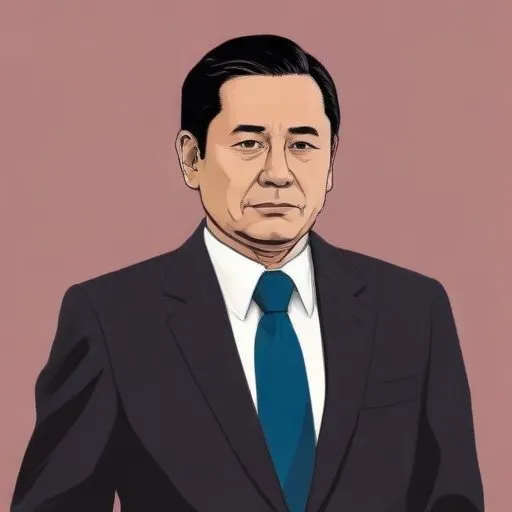
A Japanese politician who served as the Mayor of Osaka and was a key figure in the country's post-war reconstruction, known for his efforts to revitalize the city's economy.
Kazuo Kitagawa is a Japanese politician and lawyer, best known for his role as the Minister of Land, Infrastructure, and Transport in the Japanese Cabinet of Junichiro Koizumi. During his tenure, he oversaw the development of Japan's infrastructure, leaving an indelible mark on the country's landscape.
Born on March 2, 1953, in Ikunoku, Osaka, Kitagawa graduated from the Faculty of Law at Soka University. He began his career as a lawyer, eventually entering the world of politics.
In 1990, Kitagawa was elected to the House of Representatives for the first time, marking the beginning of his illustrious political career. He became a member of the New Komeito party and quickly rose through the ranks, becoming the Minister of Land, Infrastructure, and Transport in 2004.
During his tenure as Minister, Kitagawa oversaw the development of Japan's infrastructure, focusing on projects that promoted economic growth and improved the quality of life for citizens. His initiatives included the expansion of highway networks, the development of high-speed rail systems, and the revitalization of rural areas.
Kitagawa's commitment to infrastructure development earned him recognition both domestically and internationally. He is credited with transforming Japan's transportation system, making it one of the most efficient and modern in the world.
In 2009, the New Komeito party suffered a significant defeat in the Japanese general election, resulting in the loss of ten seats, including Kitagawa's. However, he was appointed as the deputy president of the party, demonstrating his continued influence within the political sphere.
In 2012, Kitagawa regained his seat in the House of Representatives, representing the Osaka 16th district. He retained his seat in the 2014 general election, solidifying his position as a prominent figure in Japanese politics.
Kitagawa's political philosophy is centered around the concept of "people-centered" politics, emphasizing the importance of investing in infrastructure to improve the daily lives of citizens. He believes that a strong infrastructure is essential for economic growth, social development, and national prosperity.
Kitagawa's contributions to Japan's infrastructure development have had a profound impact on modern society. His initiatives have improved transportation networks, reduced congestion, and increased economic opportunities, ultimately enhancing the quality of life for millions of people.
As a respected politician and lawyer, Kitagawa's legacy extends beyond his accomplishments as Minister. He has inspired a new generation of politicians and policymakers to prioritize infrastructure development, ensuring a brighter future for Japan and its people.
72 Years Old
The first Japanese leader to visit Pearl Harbor, he strengthened Japan's economy and international relations through bold policies and diplomatic efforts. He's known for his nationalist views and efforts to revise Japan's pacifist constitution.
69 Years Old
The 62nd Prime Minister of Japan, a lawyer-turned-politician who led the country from 2011 to 2012, known for his efforts to rebuild Japan after the devastating Fukushima nuclear disaster. He's also recognized for increasing the country's consumption tax to tackle its massive debt.
80 Years Old
The 61st Prime Minister of Japan, a lawyer-turned-politician who led the country during the 2011 Fukushima Daiichi nuclear disaster, implementing reforms and advocating for renewable energy. He's known for his efforts to phase out nuclear power and promote sustainable energy.
79 Years Old
A Japanese engineer-turned-politician who served as Prime Minister of Japan from 2009 to 2010, known for his efforts to reform the country's economy and politics.
84 Years Old
A Japanese lawyer and politician who served as Minister of Home Affairs, known for his influential role in shaping the country's politics and economy. He's a key figure in Japan's post-war political landscape.
86 Years Old
A Japanese target shooter turned politician who served as the country's 92nd Prime Minister, known for his brief yet tumultuous tenure marked by scandals and controversies.
