


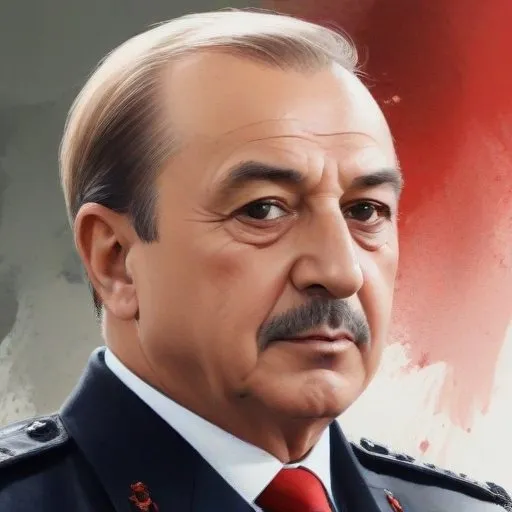
The 7th President of Turkey, a military leader who seized power in a 1980 coup, implemented a new constitution, and oversaw a period of relative stability and economic growth. He's also known for his authoritarian rule and human rights abuses.
Known for leading the 1980 military coup that overthrew the government of Turkey, Kenan Evren is a figure of controversy and intrigue in Turkish politics. As the seventh President of Turkey, Evren ruled the country from 1980 to 1989, leaving a lasting impact on Turkey's history, politics, and society.
Born on July 17, 1917, in Alaşehir, Manisa Province, Turkey, Evren's early life was shaped by his family's Albanian and Turkish roots. His father, an imam, was from the town of Preevo and had immigrated to Turkey, while his mother was from a Turkish-Bulgarian background. Evren's education took him to military high school in Maltepe, Ankara, and later to army school, where he graduated in 1938.
Evren's military career saw him rise through the ranks, serving in various posts, including as the commander of Operation Gladios, a Turkish branch of the Counter-Guerrilla, an anticommunist stay-behind guerrilla force set up with the support of NATO. He became Chief of General Staff in March 1978, a position that would catapult him to national prominence.
The years leading up to the coup were marked by violence and political instability, with right-wing and left-wing militants clashing on the streets. Evren, seen as a neutral figure, was chosen by Prime Minister Bülent Ecevit to lead the military intervention. On September 12, 1980, Evren led the military coup, which resulted in the overthrow of Prime Minister Süleyman Demirel's government and the abolition of the parliament, senate, and constitution.
Evren's presidency was marked by a mix of authoritarian rule and economic reforms. He implemented policies aimed at stabilizing the economy, but his regime was also criticized for human rights abuses and suppression of dissent. In 2014, Evren was sentenced to life imprisonment and demotion of his military rank for his role in the 1980 coup, although the sentence was under appeal at the time of his death in 2015.
Evren's personal life was marked by simplicity and humility. He was known for his austere lifestyle, and his wife, Sekine Evren, was a supportive partner throughout his career. Despite his authoritarian tendencies, Evren believed in the importance of democracy and the rule of law. In his later years, he expressed regret for some of the actions taken during his presidency.
Evren's legacy is complex and multifaceted. His presidency marked a turning point in Turkey's political history, and his economic reforms laid the foundation for the country's modern economy. However, his authoritarian rule and human rights abuses left a stain on his reputation. Today, Evren remains a controversial figure, with some viewing him as a hero who brought stability to a tumultuous country, while others see him as a dictator who suppressed democracy.
Despite his controversial legacy, Kenan Evren remains an important figure in Turkish history, a testament to the complex and often fraught nature of politics and power.
Born in 1881
Founder of modern Turkey, leading the country's transition from the Ottoman Empire to a secular, democratic nation, and implementing sweeping reforms in education, law, and women's rights.
Born in 1884
Led Turkey's transition to a secular, democratic state, and played a key role in the country's modernization. He's remembered for his efforts to establish a strong, independent Turkey.
Born in 1883
The third President of Turkey, serving from 1950 to 1960, known for his role in transitioning the country from a one-party to a multi-party system. He played a significant part in shaping Turkey's modern political landscape.
Born in 1924
A Turkish engineer-turned-politician who served as the country's 9th President, known for his efforts to modernize Turkey's economy and infrastructure. He played a key role in shaping Turkey's politics and economy during the latter half of the 20th century.
Born in 1925
A Turkish journalist, scholar, and politician who served as the 16th Prime Minister of Turkey, known for his progressive policies and literary works. He played a significant role in shaping Turkey's modern politics and culture.
99 Years Old
A Turkish engineer and politician who served as the 8th President of Turkey, known for implementing economic reforms and liberalizing the country's economy. He's also credited with modernizing Turkey's infrastructure and industry.
85 Years Old
The 10th President of Turkey, a judge-turned-politician who played a crucial role in shaping the country's democratic landscape, known for his commitment to secularism and human rights.
75 Years Old
The 11th President of Turkey, a politician and academic who played a key role in shaping Turkey's modern politics and foreign policy, known for his efforts to strengthen Turkey's ties with the EU.
