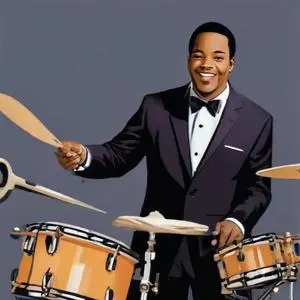
Kenny Clarke: The Drumming Pioneer of Bebop
A Legendary Jazz Drummer and Bandleader
Kenny Clarke, nicknamed "Klook," was a renowned American jazz drummer and bandleader, best known for pioneering the bebop style of drumming. He revolutionized the way drummers kept time, using the ride cymbal instead of the hi-hat, and introduced irregular accents with the bass drum, creating a unique "dropping bombs" effect.
Early Life and Career
Born on January 9, 1914, in Pittsburgh, Pennsylvania, Clarke's life took a dramatic turn when he became an orphan at the age of five. However, his teacher at the orphanage recognized his talent and encouraged him to start playing the drums at eight or nine years old. By 1931, at just seventeen, Clarke turned professional and moved to New York City in 1935, where he began to establish his drumming style and reputation.
Birth of Bebop
As the house drummer at Mintons Playhouse in the early 1940s, Clarke participated in the after-hours jams that led to the birth of bebop. These sessions, featuring musicians like
Dizzy Gillespie,
Charlie Parker, and
Thelonious Monk, marked the beginning of a new era in jazz. Clarke's innovative drumming style, characterized by fast tempos and complex rhythms, played a significant role in shaping the bebop sound.
Military Service and Parisian Sojourn
During World War II, Clarke served in the US and Europe between 1943 and 1946. After his military service, he returned to New York, but from 1948 to 1951, he was mostly based in Paris, where he absorbed European jazz influences and began to develop his unique style.
Modern Jazz Quartet and Miles Davis
Upon his return to New York in 1951, Clarke became a member of the Modern Jazz Quartet and played on early
Miles Davis recordings. This period saw him solidify his position as a leading jazz drummer.
Parisian Years and the Kenny Clarke-Francy Boland Big Band
In 1956, Clarke permanently relocated to Paris, where he performed and recorded with European and visiting American musicians. One of his most notable collaborations was with pianist Francy Boland, with whom he co-led the Kenny Clarke-Francy Boland Big Band between 1961 and 1972.
Legacy and Impact
Throughout his career, Clarke worked with jazz legends like
John Coltrane,
Sonny Rollins, and
Ella Fitzgerald. He continued to perform and record until the month before his death on January 26, 1985, leaving behind a rich legacy in the world of jazz. Clarke's innovative drumming style and contributions to bebop paved the way for future generations of jazz musicians.
Inspirational Quotes and Sayings
- "I try to play the way I feel, and I feel the way I am."
- "The most important thing in music is the thing that can't be written down."
Awards and Honors
Clarke received numerous accolades for his contributions to jazz, including a place in the DownBeat Jazz Hall of Fame and the French government's highest honor, the Ordre des Arts et des Lettres.
FAQ
What is Kenny Clarke known for?
Kenny Clarke was an American jazz drummer and bandleader who was one of the most influential drummers in jazz history, known for his work with the Modern Jazz Quartet and as a solo artist.
What was Kenny Clarkes drumming style like?
Kenny Clarkes drumming style was characterized by his use of subtle dynamics, intricate rhythms, and a strong sense of swing, which influenced generations of jazz drummers.
What were Kenny Clarkes notable recordings?
Kenny Clarke recorded with many jazz legends, including Charlie Parker, Thelonious Monk, and Miles Davis, and made several influential albums as a leader, including Telefunken Blues and Bohemia After Dark.
What was Kenny Clarkes role in the Modern Jazz Quartet?
Kenny Clarke was a founding member of the Modern Jazz Quartet, a highly influential jazz ensemble that explored the intersection of jazz and classical music.
What was Kenny Clarkes legacy?
Kenny Clarkes legacy is one of innovative and influential drumming that continues to inspire jazz musicians today, with his music remaining a vital part of the jazz canon.