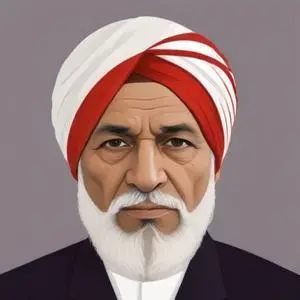
Khan Abdul Ghaffar Khan: The Frontier Gandhi
A Champion of Non-Violent Resistance
Khan Abdul Ghaffar Khan, also known as Bacha Khan, was a Pashtun independence activist who fought for India's independence from British rule and later advocated for a united, secular India. He is most famously known for his philosophy of non-violent resistance, which earned him the nickname "The Frontier Gandhi."
Early Life and Education
Born on February 6, 1890, in Charsadda, British India (now Pakistan), Khan Abdul Ghaffar Khan came from a prosperous farming family. He was the first child of Abdul Bahram Khan and Mehraj Bibi. Khan was educated at the Aligarh Muslim University, where he was exposed to the ideals of Indian nationalism and the fight for independence.
Philosophical Contributions and Beliefs
Khan Abdul Ghaffar Khan's philosophy was deeply rooted in non-violent resistance, which he believed was the most effective way to bring about change. He was heavily influenced by
Mahatma Gandhi's ideology of non-violence and civil disobedience. Khan later developed his own philosophy, which emphasized the importance of self-purification, self-discipline, and the power of the human spirit.
Career Highlights and Major Works
In 1929, Khan Abdul Ghaffar Khan founded the Khudai Khidmatgars (Servants of God), a non-violent resistance movement that aimed to free the North-West Frontier Province (now Khyber Pakhtunkhwa) from British colonial rule. The movement was characterized by its simplicity, discipline, and self-sacrifice. The Khudai Khidmatgars played a significant role in India's struggle for independence, and Khan was jailed several times for his activism.
Personal Milestones and Key Life Events
- 1920: Khan Abdul Ghaffar Khan met Mahatma Gandhi, who would later become a close friend and mentor.
- 1930: Khan was arrested for the first time for his involvement in the non-cooperation movement.
- 1947: India gained independence, and Khan Abdul Ghaffar Khan continued to advocate for a united, secular India.
Influence on Modern Society
Khan Abdul Ghaffar Khan's philosophy of non-violent resistance has inspired movements and leaders around the world. His emphasis on self-purification, self-discipline, and the power of the human spirit has made him a revered figure in Indian and Pakistani history.
Quotes and Memorable Sayings
- "I am going to give you a weapon. It is the strongest weapon. It is the weapon of the Prophet, but it is not the sword. It is the weapon of the Prophet, but it is not the bullet. It is the strongest weapon, because it is the weapon of Love."
- "There is nothing surprising in a Muslim or a Pashtun being a nationalist. But I am a nationalist, who is a Muslim and a Pashtun."
Historical Context and Legacy
Khan Abdul Ghaffar Khan's legacy extends beyond his role in India's struggle for independence. He is remembered as a champion of human rights, a advocate for education, and a symbol of non-violent resistance. His philosophy continues to inspire movements and leaders today, and his legacy serves as a testament to the power of peaceful protest.
Awards and Honors
- 1958: Khan Abdul Ghaffar Khan was awarded the Bharat Ratna, India's highest civilian honor.
- 1985: He was posthumously awarded the Nishan-e-Imtiaz, Pakistan's highest civilian honor.
Khan Abdul Ghaffar Khan's life and philosophy serve as a powerful reminder of the importance of non-violent resistance and the power of the human spirit. His legacy continues to inspire generations, and his contributions to India's struggle for independence remain a testament to his unwavering commitment to the cause.
FAQ
What was Khan Abdul Ghaffar Khans role in the Indian independence movement?
Khan Abdul Ghaffar Khan was a Pakistani activist and politician who played a key role in the Indian independence movement. He was a close friend and ally of Mahatma Gandhi and advocated for non-violent resistance against British rule.
What was Khan Abdul Ghaffar Khans philosophy?
Khan Abdul Ghaffar Khan was a strong advocate for non-violent resistance and believed in the power of love and compassion to bring about social change. He was also a strong advocate for womens rights and education.
What was Khan Abdul Ghaffar Khans relationship with Mahatma Gandhi?
Khan Abdul Ghaffar Khan was a close friend and ally of Mahatma Gandhi, with whom he shared a commitment to non-violent resistance. He was often referred to as the Frontier Gandhi due to his close relationship with Gandhi.
What was Khan Abdul Ghaffar Khans role in Pakistani politics?
Khan Abdul Ghaffar Khan was a key figure in Pakistani politics and served as a member of the Pakistani Parliament. He was a strong advocate for democracy and human rights and was critical of military rule in Pakistan.
What is Khan Abdul Ghaffar Khans legacy?
Khan Abdul Ghaffar Khan is remembered as a champion of non-violent resistance and a pioneer of human rights in Pakistan. His legacy continues to inspire activists and politicians around the world to work towards a more just and peaceful society.