


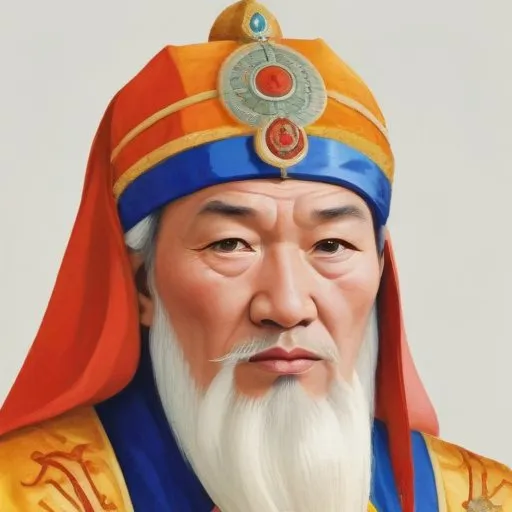
The Mongolian emperor who ruled China's Yuan dynasty, known for his military campaigns and administrative reforms that strengthened the empire. He was a skilled warrior and leader who expanded Mongol territories.
Khutughtu Khan Kusala, born in 1300, was a renowned Mongolian emperor and the 13th Great Khan of the Mongol Empire, although his reign was limited to a brief period in 1329. He is best known for his tumultuous life, which involved exile, strife, and ultimately, a short but significant reign as the Emperor of China.
Khutughtu Khan Kusala was the eldest son of Khayishan, also known as Emperor Wuzong of the Yuan dynasty of China, and a Mongolian-Ikhires woman. His early life was marked by the rivalry between his father and his younger brother Ayurbarwada, which would shape the course of his destiny.
During his exile in Central Asia, Khutughtu Khan Kusala married Mailaiti, a daughter of Temuder of the Qarluq, and gained the support of the Chagatayid princes. He eventually returned to China and seized the throne in 1329, but his reign was short-lived, ending with his death on August 30, 1329.
Although Khutughtu Khan Kusala's reign was brief, he played a significant role in the history of the Mongol Empire and the Yuan dynasty of China. His life serves as a testament to the complexities of power struggles and the importance of alliances in the medieval period.
As a nomadic emperor, Khutughtu Khan Kusala's legacy extends beyond his brief reign, reflecting the intricate relationships between the Mongol Empire and the surrounding regions. His story is a reminder of the importance of understanding the historical context and the human experiences that shaped the course of empires.
Khutughtu Khan Kusala's life may have been marked by turmoil and strife, but his legacy serves as a testament to the enduring impact of the Mongol Empire and the Yuan dynasty of China.
Born in 1186
The second Great Khan of the Mongol Empire, who expanded the empire's territories through military campaigns and established trade routes, is most known for his military conquests and administrative skills. He played a crucial role in shaping the Mongol Empire's governance and economy.
Born in 1209
The Mongolian emperor who expanded the Mongol Empire, conquering vast territories and establishing a vast network of trade routes, while also promoting religious tolerance and meritocracy.
Born in 1215
Founded the Yuan dynasty in China, extending the Mongol Empire's reach and establishing trade routes, cultural exchange, and administrative systems that shaped the region's development.
Born in 1320
The last emperor of the Yuan dynasty in China, he's known for his attempts to restore the Mongol Empire to its former glory, but ultimately failed to prevent its decline.
Born in 1320
The last emperor of the Yuan dynasty in China, he's known for his attempts to restore the Mongol Empire to its former glory, but ultimately failed to prevent its decline.
