


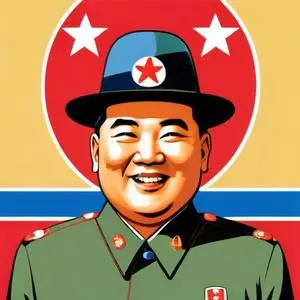
The founder of North Korea, who established a communist dynasty and ruled with an iron fist, known for his cult of personality and authoritarian regime. He's also credited with developing the country's Juche ideology.
Kim Il Sung, the enigmatic leader who spearheaded the formation of North Korea, remains an intriguing figure in modern history. Known as the "Eternal President," he ruled the country with an iron fist from its inception in 1948 until his death in 1994, leaving behind a legacy of socialism, nationalism, and authoritarianism.
Born Kim Sung Ju on April 15, 1912, in Mangyongdae, Korea, Kim Il Sung's early life was marked by resistance against Japanese colonial rule. He adopted his nom de guerre, Kim Il Sung, in 1935, which translates to "Kim Become the Sun." His involvement in the Korean independence movement led to his exile in China, where he joined the Communist Party and received military training.
Kim Il Sung's philosophical contributions are rooted in his concept of Juche, or self-reliance. This ideology emphasized Korean nationalism, independence, and autonomy, which became the guiding principle of North Korea's foreign policy and domestic development. Juche was a response to the country's historical experience of colonialism and occupation, and Kim Il Sung saw it as a means to overcome dependency on foreign powers.
After Japan's defeat in World War II, Kim Il Sung returned to Korea and established the Democratic People's Republic of Korea (North Korea) in 1948. He became the country's supreme leader, a position he held until his death. In 1950, he authorized the invasion of South Korea, triggering the Korean War. The conflict ended in a stalemate in 1953, but not before claiming millions of lives and dividing the peninsula.
Under Kim Il Sung's leadership, North Korea became a totalitarian socialist state with a centrally planned economy. The government controlled all aspects of life, including the economy, media, and education. While the country made rapid economic progress in the 1950s and 1960s, it stagnated in the 1970s and 1980s, largely due to its isolationist policies and dependence on Soviet subsidies.
Kim Il Sung's rule was marked by human rights abuses, strict censorship, and a pervasive cult of personality. His regime was notorious for its propaganda, forced labor camps, and brutal suppression of dissent. Despite these controversies, he remains a revered figure in North Korea, and his legacy continues to shape the country's politics and economy.
"The people are the masters of the revolution, and the people's government is the servant of the people."
"Self-reliance is the fundamental principle of the revolution."
Kim Il Sung's legacy is complex and multifaceted. He played a significant role in shaping modern Korean history, and his influence extends beyond North Korea to the broader region. His philosophy of Juche continues to inspire nationalistic and anti-imperialist movements around the world.
In conclusion, Kim Il Sung's life and rule were marked by contradictions – authoritarianism and socialism, nationalism and isolationism, progress and stagnation. As the founder of North Korea, he left an indelible mark on modern history, and his legacy continues to fascinate and intrigue scholars, policymakers, and the general public.
85 Years Old
The authoritarian leader who ruled North Korea with an iron fist, known for his eccentric personality, love of cinema, and development of nuclear weapons. He maintained a cult of personality and controlled the country's economy and military.
44 Years Old
The authoritarian leader of North Korea, known for his brutal regime, nuclear ambitions, and eccentric personality. He has been the center of international attention and controversy for over a decade.
Born in 1893
Leader of the Chinese Communist Party who implemented radical social and economic reforms, including the Great Leap Forward and the Cultural Revolution, shaping modern China's politics and economy.
Born in 1878
The Soviet Union's ruthless leader who ruled with an iron fist, implementing policies that led to widespread famine and purges, while also playing a crucial role in defeating Nazi Germany in World War II.
Born in 1870
Founder of the world's first socialist state, leading the Bolshevik Revolution and establishing the Soviet Union, known for his radical Marxist ideology and authoritarian rule.
Born in 1890
Leader of North Vietnam during the Vietnam War, unifying the country under communist rule and earning international recognition as a symbol of resistance against colonialism and imperialism.
99 Years Old
The Cuban revolutionary who led the country from 1959 to 2008, implementing socialist policies and defying US opposition, becoming an iconic figure in modern history.
Born in 1894
The Soviet leader who initiated reforms and denounced Stalin's regime, known for his bold policies and iconic shoe-banging incident at the UN.
