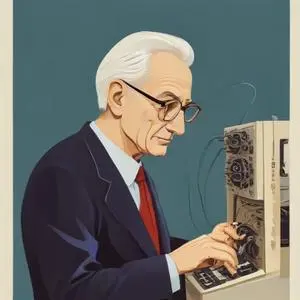
Konrad Zuse: The Architect of Modern Computing
A Pioneer in the Realm of Programmable Computers
Konrad Zuse, a German civil engineer, computer scientist, inventor, and businessman, etched his name in the annals of history by creating the world's first programmable computer, the Z3, in May 1941. This groundbreaking innovation earned him the reputation as the "father of the modern computer," revolutionizing the way we interact with technology today.
Early Life and Educational Pursuits
Born on June 22, 1910, in Berlin, Germany, Zuse's family moved to East Prussian Braunsberg (now Braniewo, Poland) when he was just two years old. His fascination with engineering and architecture led him to enroll in the Technical University of Berlin, where he graduated in 1935 with a degree in civil engineering.
The Genesis of Modern Computing
Zuse's journey in computing began in the 1930s, when he designed the Z1, the first fully automatic digital computer. He continued to refine his designs, ultimately creating the Z3, a functional, program-controlled, Turing-complete machine. This pioneering achievement set the stage for the development of modern computers.
Commercial Ventures and Government Support
In 1941, Zuse founded one of the earliest computer businesses, producing the Z4, which became the world's first commercial computer. His work initially received financial backing from his family and private commerce, but from 1939 onwards, the Nazi government provided resources for his projects.
War, Secrecy, and Global Impact
Due to World War II, Zuse's work remained largely unknown in the United Kingdom and the United States until the 1940s. However, in 1946, IBM took notice of his innovations, acquiring an option on his patents. This marked the beginning of his influence on the global computer industry.
Plankalkül: Pioneering Programming Language
During the war years, Zuse designed Plankalkül, the first high-level programming language, between 1943 and 1945. This achievement, combined with his work on the Z3, solidified his position as a trailblazer in the field of computer science.
Philosophical Contributions: The Concept of Calculating Space
In his 1969 book, "Rechnender Raum" (Calculating Space), Zuse proposed the concept of a computation-based universe, challenging traditional notions of space and time. This philosophical contribution sparks intriguing questions about the nature of reality and the role of computation in understanding the cosmos.
Legacy and Impact on Modern Society
Konrad Zuse's contributions have had a profound impact on the development of modern computing, influencing generations of computer scientists and engineers. His work paved the way for the creation of modern computers, which have transformed industries, revolutionized communication, and reshaped the fabric of our daily lives.
- Awards and Honors: Zuse received numerous honors, including the Werner-von-Siemens-Ring in 1964 and the Harry H. Goode Memorial Award in 1965.
- Personal Milestones: Zuse married Gisela Brandenburg in 1945, and the couple had five children together.
- Influence on Pop Culture: Zuse's work inspired the creation of the first computer-generated movie, "A Computer Animated Hand," in 1972.
A Lasting Legacy in the Realm of Computing
Konrad Zuse's remarkable achievements have secured his place in the annals of computer science history. As we continue to push the boundaries of technology, we must acknowledge the pioneering spirit and innovative genius of this German visionary, whose contributions have shaped the modern computing landscape.
FAQ
What was Konrad Zuses contribution to computer science?
Konrad Zuse, a German computer scientist and engineer, invented the Z3 computer, one of the first fully automatic digital computers. His innovations in computer design and programming laid the foundations for modern computing.
What was Konrad Zuses early life and education like?
Konrad Zuse was born in Berlin, Germany in 1910. He studied mechanical engineering at the Technical University of Berlin, where he became interested in computer design and built his first computer, the Z1, in 1936.
What impact did Konrad Zuse have on the development of computers?
Konrad Zuses inventions and innovations in computer design had a significant impact on the development of computers. His work influenced the development of computers in the 1940s and 1950s, and his company, Zuse KG, became a leading manufacturer of computers in Germany.
What awards and recognition did Konrad Zuse receive?
Konrad Zuse received numerous awards and honors for his contributions to computer science, including the Werner von Siemens Ring in 1964 and the Harry H. Goode Memorial Award in 1965.
What is Konrad Zuses legacy in modern computing?
Konrad Zuses legacy in modern computing is significant, as his inventions and innovations paved the way for the development of modern computers. He is considered one of the pioneers of computer science and is remembered as a pioneer in the field of computing.