


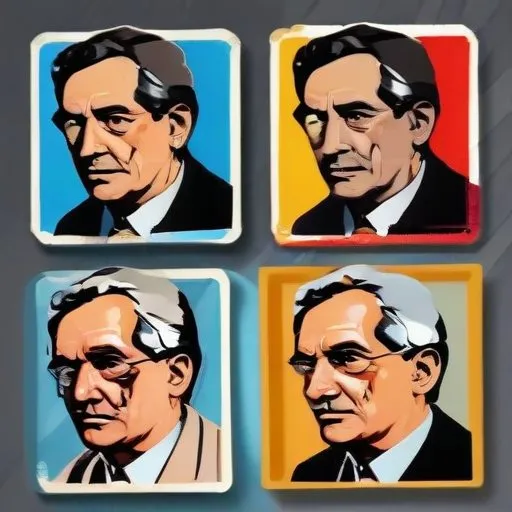
A Greek physician-turned-politician who served as Prime Minister of Greece during World War II, known for his role in the country's tumultuous wartime history. He's infamous for collaborating with the Nazi occupation forces.
Konstantinos Logothetopoulos was a prominent Greek medical doctor who, amidst the turbulence of World War II, found himself at the helm of the Greek collaborationist government. His tenure as Prime Minister of Greece, from December 1942 to April 1943, was marked by controversy and complexity, forever etching his name in the annals of Greek history.
Born in Nafplion, Greece in 1878, Logothetopoulos pursued his passion for medicine in Munich, Germany. He spent several years practicing and teaching medicine in the German Empire before relocating to Athens in 1910. In Greece, he established a private clinic and served as a doctor in both the First and Second Balkan Wars.
After being discharged from military service in 1916, Logothetopoulos resumed his private medical practice until 1922, when he was conscripted again during the Greco-Turkish War. Following the war, he became a professor of gynaecology at the National and Kapodistrian University of Athens, eventually rising to the position of Dean.
During his tenure at the university, Logothetopoulos taught and mentored many young doctors, including future politician Grigoris Lambrakis. His fluency in German and connections to the German establishment – his wife was the niece of Field Marshal Wilhelm List – made him an attractive candidate for the Greek-German Council.
When Greece fell to Nazi Germany after the Battle of Greece, Logothetopoulos was appointed Vice President and Minister of Education in the first collaborationist government of Gen. Georgios Tsolakoglou. His subsequent appointment as Prime Minister marked the beginning of a tumultuous period in Greek history.
Logothetopoulos's short-lived tenure as Prime Minister, from December 1942 to April 1943, was marred by controversy. During this period, the deportation of Greek Jewry began, and his role in this tragic event remains shrouded in ambiguity.
As the Wehrmacht withdrew from Greece in 1944, Logothetopoulos accompanied them to Nazi Germany, where he lived in exile with his wife and daughter.
Konstantinos Logothetopoulos's legacy is complex and multifaceted, reflecting both his contributions to Greek medicine and education and his complicity in the collaborationist government during World War II. His involvement in the deportation of Greek Jewry has sparked intense debate and criticism among historians and scholars.
Ultimately, Logothetopoulos's story serves as a poignant reminder of the complexities and moral ambiguities of wartime politics, and the enduring impact of individual choices on the course of history.
Born in 1902
A Greek philosopher and politician who served as the 138th Prime Minister of Greece, known for his brief but significant term during a tumultuous period in Greek history. He played a key role in shaping the country's post-war politics.
Born in 1898
Greek Prime Minister from 1996 to 2004, known for his efforts to reform the Greek economy and prepare the country for the Eurozone. He also played a key role in resolving the Macedonia naming dispute.
Born in 1918
Greek lawyer and politician who served as the 178th Prime Minister of Greece, known for his efforts to modernize and liberalize the Greek economy. He played a key role in Greece's accession to the European Union.
Born in 1919
Greek economist and politician who served as Prime Minister of Greece, known for his socialist policies and efforts to reduce Greece's reliance on foreign capital. He also played a key role in Greece's accession to the European Union.
Born in 1918
A Greek lieutenant-turned-politician who served as the 173rd Prime Minister of Greece, known for his brief but tumultuous tenure during a period of political and economic crisis.
Born in 1910
Greek Minister of Defence who played a crucial role in shaping Greece's military and foreign policy during the Cold War era, particularly in the 1960s and 1970s.
Born in 1888
A Greek lawyer, economist, and politician who served as the Prime Minister of Greece from 2009 to 2011, known for his efforts to address the country's debt crisis.
