


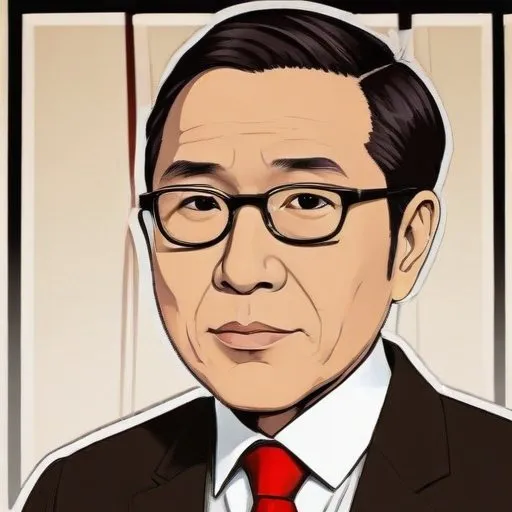
A Japanese lawyer and politician who served as the President of the Japanese Socialist Party and played a key role in shaping post-war Japan's political landscape. He's known for his efforts to promote democratic socialism and labor rights.
Kyuichi Tokuda, a Japanese politician, is renowned for being the first chairman of the Japanese Communist Party, leading the party from 1945 until his untimely death in 1953. During his tenure, he played a pivotal role in shaping the party's ideologies and fought tirelessly for the rights of the working class.
Born on September 12, 1894, in Okinawa, Japan, Tokuda pursued a degree in law from Nihon University, graduating in 1920. His early career as a lawyer paved the way for his future involvement in politics.
Tokuda's fascination with communism led him to join the Japanese Communist Party in 1922, shortly after its formation. He quickly rose through the ranks, becoming a member of the Central Committee, and participated in the formation of the outlawed Japanese Communist Party in 1922.
In 1928, Tokuda was arrested under suspicion of violating the Peace Preservation Law, and subsequently spent 18 years in prison, including a stint at Abashiri Prison from 1934 to 1940. Despite the harsh conditions, his resolve remained unwavering, and he continued to advocate for the rights of the working class.
In 1945, Tokuda was discovered and released from prison by French journalist Robert Guillain, who visited the Fuchu Prison. Upon his release, he was received as a hero by the communist community, who hoisted him onto their shoulders, chanting anti-imperialist slogans.
After World War II, Tokuda was elected to the House of Representatives in the 1946 general election, alongside his cousin, Senzo Nosaka. He became a key figure in the Japanese Communist Party, playing a crucial role in the 1947 general strike and surviving an assassination attempt in 1948.
In 1946, Tokuda married Tatsu Tokuda, the widow of his cousin Kosaku. This union strengthened his family ties and further solidified his position within the party.
Kyuichi Tokuda's unwavering commitment to the Japanese Communist Party and its ideologies has left an indelible mark on Japanese politics. His leadership and perseverance have inspired generations of communists, cementing his place as a pivotal figure in Japanese history.
Through his life, Kyuichi Tokuda demonstrated an unwavering commitment to his ideals, facing persecution and imprisonment with resolute determination. His legacy continues to inspire and educate, serving as a testament to the power of conviction and dedication.
72 Years Old
The first Japanese leader to visit Pearl Harbor, he strengthened Japan's economy and international relations through bold policies and diplomatic efforts. He's known for his nationalist views and efforts to revise Japan's pacifist constitution.
69 Years Old
The 62nd Prime Minister of Japan, a lawyer-turned-politician who led the country from 2011 to 2012, known for his efforts to rebuild Japan after the devastating Fukushima nuclear disaster. He's also recognized for increasing the country's consumption tax to tackle its massive debt.
80 Years Old
The 61st Prime Minister of Japan, a lawyer-turned-politician who led the country during the 2011 Fukushima Daiichi nuclear disaster, implementing reforms and advocating for renewable energy. He's known for his efforts to phase out nuclear power and promote sustainable energy.
79 Years Old
A Japanese engineer-turned-politician who served as Prime Minister of Japan from 2009 to 2010, known for his efforts to reform the country's economy and politics.
