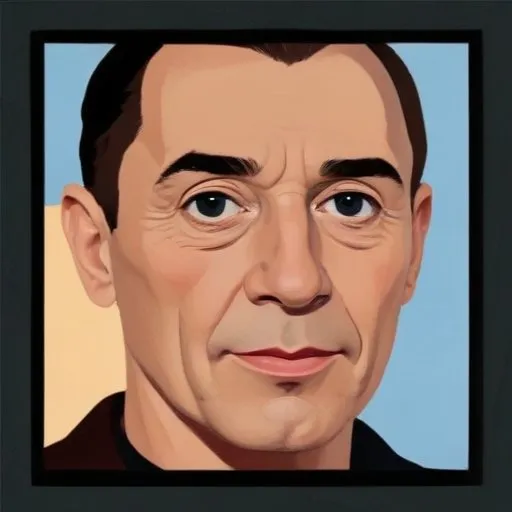
Larry Rivers: The Pioneering Pop Artist
A Leader in the New York School
Larry Rivers, born Yitzroch Loiza Grossberg in 1923, is renowned for his groundbreaking contributions to the Pop Art movement. As one of the first artists to merge non-objective, non-narrative art with narrative and objective abstraction, Rivers is often referred to as the "Godfather" and "Grandfather" of Pop Art.
Early Life and Career
Born in the Bronx, New York, to a family of Jewish immigrants from Ukraine, Rivers' artistic journey began in 1945. He honed his skills at the
Hans Hofmann School from 1947 to 1948 and later earned a BA in art education from New York University in 1951. His early work caught the attention of the Museum of Modern Art, which promptly acquired several of his pieces.
Breaking Boundaries
Rivers' innovative approach to art involved reproducing everyday objects of American popular culture, often using bold colors and graphic forms. This unique style earned him a spot among the prominent New York School of artists, alongside the likes of
Willem de Kooning and
Jasper Johns. His 1953 painting,
Washington Crossing the Delaware, although damaged in a fire at the Museum of Modern Art, remains an iconic representation of his early work.
Influences and Collaborations
During the early 1960s, Rivers resided at the famous Hotel Chelsea, a hub for artistic innovation. It was here that he befriended fellow creatives, including
Bob Dylan,
Janis Joplin, and
Andy Warhol's Factory associates. Rivers also introduced several French Nouveau Réalistes, such as
Yves Klein, Arman, and Christo, to the American art scene. These connections had a profound impact on his artistic development, shaping his exploration of new techniques and mediums.
Major Works and Exhibitions
Rivers' prolific career was marked by numerous notable exhibitions, including a comprehensive retrospective in 1965 that traveled across five prominent American museums. One of his final works for the exhibition,
The History of the Russian Revolution, showcases his ability to synthesize historical narrative with abstract expressionism.
Philosophical Contributions and Beliefs
Rivers' art often blurred the lines between high and low culture, challenging traditional notions of artistic expression. His commitment to exploring the intersection of popular culture and fine art paved the way for future generations of artists. As he once stated, "I think the most important thing in art is the thing that cannot be explained."
Legacy and Impact
Larry Rivers' remarkable career has left an indelible mark on the art world. His innovative approach to Pop Art helped shape the movement, influencing artists like Andy Warhol and
Roy Lichtenstein. Rivers' work continues to inspire new generations of artists, solidifying his position as a pioneer in the world of modern art.
Trivia and Fun Facts
- Rivers was also a talented musician and occasionally acted in films.
- He was known for his charismatic personality and was often referred to as the "most charming man in the art world."
- Rivers' work can be found in prominent museums and private collections worldwide, including the Museum of Modern Art, the Whitney Museum of American Art, and the Tate Gallery.
In Closing
Larry Rivers' remarkable life and career serve as a testament to his innovative spirit and artistic genius. As a true pioneer in the world of Pop Art, his influence extends far beyond his own works, shaping the very fabric of modern art as we know it today.
FAQ
What was Larry Rivers artistic style?
Larry Rivers was an American painter and sculptor known for his innovative and eclectic style, which blended elements of abstract expressionism, pop art, and figurative art.
What was Larry Rivers most famous artwork?
Larry Rivers most famous artwork is Washington Crossing the Delaware, a series of paintings that reinterpreted the iconic American scene in a bold and irreverent style.
Did Larry Rivers experiment with different materials?
Yes, Larry Rivers was known for his experimentation with different materials, including fabric, wood, and found objects, which he incorporated into his paintings and sculptures.
What was Larry Rivers contribution to art?
Larry Rivers contribution to art was his bold and innovative approach to art-making, which challenged traditional notions of beauty and taste.
What was Larry Rivers legacy in the art world?
Larry Rivers legacy in the art world is that of a pioneering artist who pushed the boundaries of modern art and inspired future generations of artists.