


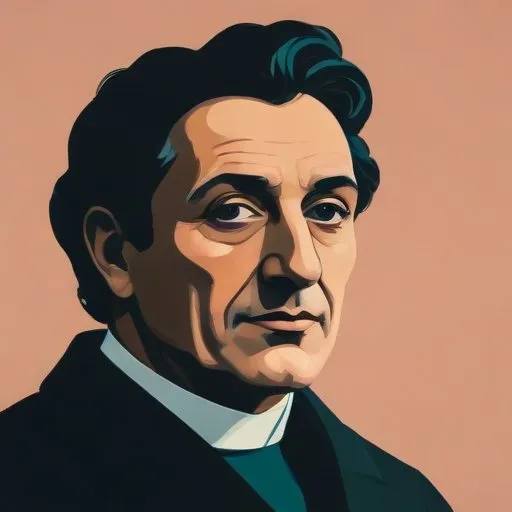
Italian humanist and reformer who advocated for religious tolerance and separation of church and state, influencing the development of modern democracy.
Lelio Sozzini, also known as Laelius Socinus, is renowned for being the founder of Socinianism, a Nontrinitarian Christian belief system that rejects the Trinity and emphasizes the unity of God. His doctrine had a profound impact on the Polish Brethren in the Polish Reformed Church and the Unitarian Church of Transylvania during the 16th and 17th centuries.
Born on January 29, 1525, in Siena, Italy, Lelio Sozzini was the sixth son of Mariano Sozzini the Younger and Camilla Salvetti. He was educated as a jurist under his father's guidance in Bologna, where he developed an interest in Biblical research, leading him to reject the idolatry of Rome.
Sozzini's theological views were shaped by his desire to reach the "fontes juris," or the sources of law. He believed that the Bible should be the sole authority in matters of faith, and that traditional Catholic dogma was flawed. He rejected the concept of the Trinity, arguing that Jesus Christ was a mere mortal, not divine. This belief system, known as Socinianism, emphasized the unity of God and the humanity of Jesus.
Sozzini's writings had a significant impact on the development of Socinianism. His nephew, Fausto Sozzini, further developed his uncle's ideas, and together they founded the Socinian movement. Sozzini's doctrine spread rapidly among the Polish Brethren and the Unitarian Church of Transylvania, shaping the theological landscape of Eastern Europe.
Sozzini's Socinianism continues to influence Christian theology to this day. His emphasis on the unity of God and the humanity of Jesus Christ has inspired numerous denominations and religious movements. His rejection of traditional Catholic dogma has contributed to the development of liberal Christianity and the promotion of individual freedom of conscience.
Sozzini's radical views on the nature of God and Jesus Christ were considered heretical by the Catholic Church, leading to controversy and persecution. Despite this, his ideas continued to spread, shaping the theological landscape of Eastern Europe and beyond.
Sozzini's writings are characterized by his emphasis on the importance of individual freedom of conscience and the authority of the Bible. He famously declared, "The Bible is the only rule of faith, and its authority is above all human traditions."
Lelio Sozzini's Socinianism emerged during a time of great theological upheaval in Europe. His rejection of traditional Catholic dogma and his emphasis on individual freedom of conscience placed him at the forefront of the Protestant Reformation. His legacy continues to inspire theologians, scholars, and laypeople alike, ensuring his place as one of the most significant figures in Christian history.
By exploring Sozzini's life, beliefs, and contributions, we gain a deeper understanding of the complexities of Christian theology and the enduring impact of Socinianism on modern society.
Born in 1539
A 16th-century theologian and author who challenged traditional Christian views, proposing a more tolerant and rational approach to faith, and writing influential works on theology and biblical criticism.
Born in 1508
An Italian Renaissance astronomer and philosopher who wrote influential works on astronomy, philosophy, and literature, including a commentary on Aristotle's "De Caelo".
Born in 1469
Italian historian and philosopher who wrote "The Prince", a seminal work on politics and power that still influences modern leadership and governance today.
Born in 1483
A Renaissance-era statesman and historian who chronicled the Italian Wars and developed a realistic approach to politics, emphasizing the role of individual ambition and self-interest. 42
Born in 1463
Renaissance humanist and philosopher who wrote the famous "Oration on the Dignity of Man," a treatise that declared human beings' potential for greatness and their capacity for self-improvement. He's known for his emphasis on humanism and individualism.
Born in 1466
A 16th-century Renaissance humanist who advocated for education, tolerance, and critical thinking, and is famous for his witty and insightful writings, particularly "In Praise of Folly".
Born in 1483
A German monk and priest who sparked the Protestant Reformation, challenging Catholic Church authority and shaping Western Christianity. He's famous for nailing 95 theses to a church door, sparking a religious revolution.
