


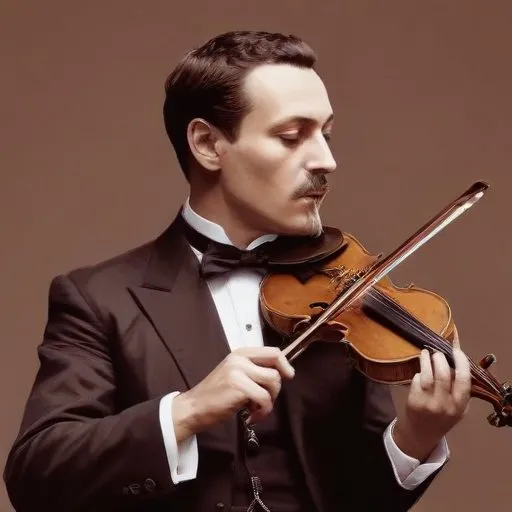
A renowned violinist, composer, and conductor who taught some of the most celebrated violinists of the 20th century, including Jascha Heifetz and Nathan Milstein. He's also known for his arrangements of violin concertos and his own compositions.
Renowned Hungarian violinist, composer, and instructor, Leopold Auer, left an indelible mark on the world of classical music. His students, many of whom became prominent concert performers and teachers, are a testament to his exceptional teaching style and dedication to the craft.
Born on June 7, 1845, in Veszprém, Hungary, Auer was destined for a life of music. He was born into a poor Jewish household of painters, where the violin was a natural choice for a musically inclined boy, as it "didn't cost much."
At the tender age of 8, Auer began his violin studies with local concertmaster, Dávid Ridley Kohne, at the Budapest Conservatory. This early training laid the foundation for his remarkable technique, which would later earn him recognition across Europe.
Auer's prodigious talent soon caught the attention of wealthy music enthusiasts, who awarded him a scholarship to study in Vienna. Under the guidance of Jakob Dont, Auer refined his technique, later crediting Dont with teaching him the foundations of his violin playing.
In Vienna, Auer also attended quartet classes with Joseph Hellmesberger, Sr., further honing his skills. By 13, the scholarship money had run out, and Auer's father took it upon himself to launch his son's career.
Auer's two-year stint with Joseph Joachim in Hanover (1861-1863) proved a turning point in his career. Joachim, then royal concertmaster, introduced Auer to the blind King of Hanover, who was fond of music. Auer's performances for the king earned him a stipend, which supported him for several weeks.
This experience not only helped Auer financially but also instilled in him the confidence to pursue a career as a violin soloist. He went on to become one of the most celebrated violinists of his time, known for his technical mastery and expressive playing style.
Auer's greatest legacy lies in the many students he taught, including some of the most prominent violinists of the 20th century. His students, including Jascha Heifetz, Mischa Elman, and Nathan Milstein, went on to become renowned concert performers and teachers in their own right.
Auer's teaching style was characterized by a focus on technical precision, musicality, and a deep understanding of the composer's intent. His book, Violin Playing as I Teach It, remains a seminal work on violin pedagogy to this day.
In addition to his work as a violinist and teacher, Auer was also a prolific composer and conductor. He wrote several works for the violin, including concertos, sonatas, and etudes, which are still performed today.
Auer's experience as a conductor was limited but significant, particularly during his tenure as the director of the Budapest Opera Orchestra (1883-1886).
Auer married twice, first to Wilhelmine Gesell in 1872, and then to Katharina Vomáčková in 1891. He had two daughters from his first marriage and two sons from his second.
Auer died on July 15, 1930, at the age of 85, leaving behind a legacy that continues to inspire and influence generations of violinists and music lovers alike.
Leopold Auer's contributions to the world of classical music are immeasurable. Through his teaching, performing, and composing, he touched the lives of countless musicians and music enthusiasts. His legacy serves as a testament to the transformative power of music and the importance of preserving the cultural heritage of classical music.
Born in 1901
A virtuosic violinist renowned for his technical perfection, tone, and phrasing, revolutionizing the art of violin playing through his recordings and teaching.
Born in 1891
A renowned virtuoso violinist celebrated for his expressive and technically precise performances, particularly in Romantic repertoire. He was a prominent figure in the early 20th-century classical music scene.
Born in 1904
A virtuosic violinist and composer, renowned for his technical mastery and poetic interpretations of classical music, particularly Bach's solo violin works.
Born in 1908
A renowned violinist and educator, known for his technical mastery and emotional depth, influencing generations of musicians with his iconic performances and pedagogical legacy.
Born in 1924
A renowned violinist and educator, celebrated for his technical mastery and emotional depth, inspiring generations of musicians.
Born in 1903
A renowned pianist and composer, celebrated for his virtuosic technique and powerful performances of classical music, particularly Chopin and Rachmaninoff.
Born in 1873
A renowned Russian musician who composed iconic symphonies and piano concertos, and was also a skilled pianist and conductor, leaving a lasting legacy in classical music.
Born in 1881
A renowned Romanian musician who excelled as a virtuosic violinist, pianist, and composer, leaving an indelible mark on the classical music world with his unique blend of folk and modernist styles.
