


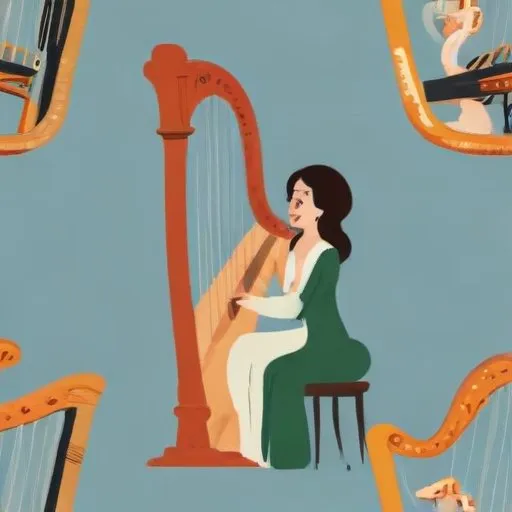
A renowned French harpist, celebrated for her expressive and technically precise performances, particularly in the classical music realm.
Lily Laskine, born on August 31, 1893, in Paris, was one of the most prominent harpists of the twentieth century, renowned for her mesmerizing performances, esteemed teaching career, and numerous awards. As a distinguished musician, she was celebrated for her virtuosity, elegance, and technical mastery, earning her a permanent place in the realm of classical music.
Lily Aime Laskine was born to Jewish parents in Paris. She began her musical journey at the Conservatoire de Paris, where she studied under the guidance of Alphonse Hasselmans, a renowned harpist and pedagogue. This marked the beginning of her lifelong dedication to the harp, an instrument that would become an integral part of her identity.
Laskine's remarkable career spanned over six decades, during which she became a frequent performing partner of several distinguished French flautists, including Marcel Moyse and Jean-Pierre Rampal. Her collaborations with these exceptional musicians resulted in some of the most iconic recordings and performances of her time. As a professor of harp at the Conservatoire de Paris from 1948 to 1958, Laskine played a significant role in shaping the next generation of harpists.
Her repertoire was vast and eclectic, encompassing works by Wolfgang Amadeus Mozart, Claude Debussy, and Camille Saint-Saëns, among others. Laskine's performances were characterized by her lyrical and expressive playing style, which earned her widespread acclaim and recognition.
In 1958, Laskine was awarded the Legion of Honour, France's highest civilian honor, in recognition of her outstanding contributions to music and education. This prestigious award solidified her position as one of the most respected and celebrated harpists of her era.
In 1936, Laskine married Roland Charmy, a violinist and academic of the Conservatoire de Paris. This union not only strengthened her connection to the musical community but also fostered a lifelong partnership that supported her artistic endeavors.
Lily Laskine's legacy extends beyond her impressive career as a harpist. She inspired generations of musicians, educators, and music enthusiasts through her teachings, performances, and recordings. Her dedication to promoting the harp as a solo instrument helped to establish it as a legitimate and integral part of classical music.
Through her tireless efforts, Laskine ensured that the harp's beauty, versatility, and expressiveness were showcased to the world, leaving an indelible mark on the music world.
In conclusion, Lily Laskine's remarkable life and career serve as a testament to her exceptional talent, dedication, and passion for music. As a harpist, educator, and advocate for her instrument, she left an enduring legacy that continues to inspire and enrich the lives of music lovers around the world.
Born in 1922
A renowned French flute virtuoso, celebrated for revitalizing interest in the Baroque flute and popularizing the instrument through numerous recordings and performances. He's credited with expanding the flute's repertoire and elevating its status in classical music.
Born in 1905
A French composer who blended modernist techniques with ancient and exotic influences, creating a unique sound that explored the intersection of Western and non-Western musical traditions.
Born in 1892
A French composer and educator who blended jazz and classical music to create a unique sound, and is best known for his ballet scores and chamber music compositions.
Born in 1899
A renowned French pianist and composer, celebrated for his eclectic and innovative works that blend jazz, classical, and sacred music, leaving a lasting impact on modern classical music.
Born in 1916
A renowned French pianist, composer, and educator, he was a prominent figure in 20th-century classical music, celebrated for his unique and innovative compositions.
