


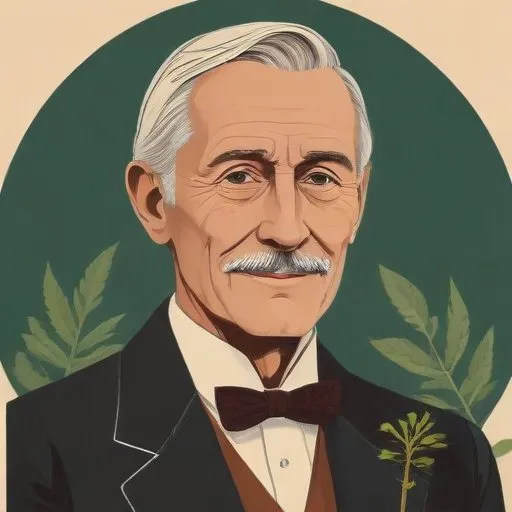
A pioneer in the field of biology, he discovered the cellular structure of plants and developed a system of classification for birds. His work laid the foundation for modern biology and ornithology.
Lorenz Oken, a renowned German naturalist, botanist, biologist, and ornithologist, is best known for his groundbreaking contributions to the field of Naturphilosophie, a philosophical and scientific movement that sought to understand the natural world through a holistic and systematic approach. His pioneering work in this field earned him a reputation as one of the leading figures of the 19th century, shaping the course of scientific inquiry and influencing generations of thinkers to come.
Born on August 1, 1779, in Bohlsbach, a small town in Baden, Germany, Oken was raised in a family that valued education and intellectual pursuits. He began his academic journey at the universities of Freiburg and Würzburg, where he studied natural history and medicine. Later, he moved to the University of Göttingen, where he became a Privatdozent (unsalaried lecturer) and shortened his name to Oken.
Oken's magnum opus, Grundriss der Naturphilosophie (1802), marked the beginning of the Naturphilosophie movement in Germany. This seminal work extended the philosophical principles of Immanuel Kant to physical science, laying the foundation for a systematic and holistic approach to understanding the natural world. Oken's innovative approach built upon the ideas of Johann Gottlieb Fichte and Friedrich Schelling, two prominent philosophers of the time.
In his Grundriss der Naturphilosophie, Oken outlined a novel system of animal classification that would later become a hallmark of his work. This system, which he continued to refine throughout his career, posited that animal classes are essentially a representation of the natural world. Oken's classification system was a significant departure from existing approaches, offering a more comprehensive and integrated understanding of the natural world.
Oken's most notable work is the seven-volume series Allgemeine Naturgeschichte für alle Stände (1839-1841), featuring engravings by Johann Susemihl. This monumental work showcased Oken's expertise in natural history, taxonomy, and philosophy, cementing his reputation as a leading authority in the field.
Oken's contributions to Naturphilosophie and his innovative approach to classification had a profound impact on the scientific community. His work influenced a wide range of fields, including biology, botany, and ornithology, shaping the course of scientific inquiry for generations to come. Today, Oken is remembered as a pioneer and a visionary, whose work continues to inspire and inform contemporary scientific research.
Oken's life was marked by a series of personal milestones, including his marriage to Sophia Dorothea Hainhold in 1804 and the birth of their three children. Despite his many achievements, Oken remained humble and dedicated to his work, continuing to write and publish until his death on August 11, 1851.
Oken's legacy serves as a testament to the power of human curiosity and the importance of interdisciplinary approaches to understanding the natural world. His work continues to inspire and inform contemporary scientific research, ensuring that his contributions to Naturphilosophie remain an integral part of our shared intellectual heritage.
Born in 1769
A pioneering geographer and explorer who mapped much of South America and discovered the Caspian Sea's connection to the Black Sea, greatly advancing our understanding of the natural world.
Born in 1707
Developed the system of binomial nomenclature, which is still used today to classify and name living organisms. This system has had a profound impact on the fields of biology, ecology, and conservation.
Born in 1744
A French soldier, biologist, and academic who developed a theory of inheritance of acquired characteristics, proposing that organisms adapt to their environment and pass on those traits to their offspring.
Born in 1769
Founded the field of comparative anatomy, establishing extinction as a fact and creating a framework for understanding the natural world through fossil records.
Born in 1749
A German literary giant who penned iconic works like "Faust" and "The Sorrows of Young Werther", shaping the Romantic movement and influencing countless writers.
Born in 1834
A German biologist, physician, and philosopher who coined the term "ecology" and made significant contributions to the field of evolutionary biology, including the recapitulation theory.
Born in 1809
Developed the theory of evolution through natural selection, revolutionizing our understanding of life on Earth. This groundbreaking idea transformed the fields of biology, ecology, and beyond.
Born in 1823
A pioneering naturalist who discovered evolution through natural selection, independently of Charles Darwin, and contributed significantly to the field of biogeography.
