


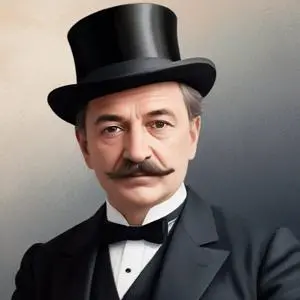
A Hungarian physicist and politician who made groundbreaking contributions to our understanding of gravity and the Earth's magnetic field, and also served as the Minister of Education of Hungary.
Lornd Etvs, a Hungarian physicist, is renowned for his groundbreaking work on gravitation and surface tension, as well as the invention of the torsion pendulum. His pioneering research has left an indelible mark on the field of physics, earning him a place among the greatest scientists of his time.
Born on July 27, 1848, in Hungary, Lornd Etvs was the son of Baron Jzsef Etvs de Vsrosnamny, a poet, writer, and liberal politician. His mother, Agnes Rosty de Barkcz, was a member of the noble family Rosty de Barkcz. Etvs's family background was steeped in intellectual and political influence, which would later shape his own path in life.
Initially, Etvs studied law, but soon switched to physics, pursuing his doctorate in Heidelberg and Knigsberg. He returned to Budapest as a university professor, where he spent almost half a century dominating Hungarian science.
Etvs's work on capillarity, the study of surface tension, led to his first international recognition. He developed innovative experimental methods and conducted extensive field studies on gravity, refining our understanding of the fundamental force of nature.
His research on gravity led to the development of the torsion pendulum, a device that measures the gravitational attraction between objects. This invention paved the way for subsequent breakthroughs in our understanding of gravity and its applications in various fields.
Etvs's contributions to physics were recognized with various awards and honors. The Etvs Lornd University and the Etvs Lornd Institute of Geophysics in Hungary bear his name, as does the Etvs crater on the Moon and the asteroid 12301 Etvs. A peak in the Dolomites, Cima Eotvos, also carries his name.
Lornd Etvs's work has had a profound impact on modern society, influencing the development of various fields, including physics, geology, and astronomy. His research on gravity has far-reaching implications for our understanding of the universe and the behavior of celestial bodies.
Etvs's legacy extends beyond his scientific contributions. He inspired future generations of scientists and thinkers, leaving behind a rich intellectual heritage that continues to shape our understanding of the world.
Etvs's personal life was marked by significant milestones. His uncle, Pl Rosty de Barkcz, was a Hungarian nobleman, photographer, and explorer who traveled extensively in the Americas. This familial connection may have sparked Etvs's own curiosity about the natural world.
Throughout his life, Etvs remained committed to his work, dedicating himself to the pursuit of knowledge and understanding. His story serves as a testament to the power of human curiosity and the impact that one individual can have on the world.
Born in 1879
A brilliant physicist who developed the theory of relativity and is considered one of the most influential scientists of the 20th century, known for his groundbreaking work in physics and mathematics.
Born in 1885
A pioneer in quantum mechanics, he introduced the concept of wave-particle duality, revolutionizing our understanding of atomic structure. His philosophical approach to science also explored the nature of reality and human understanding.
Born in 1901
A pioneer in quantum mechanics, he formulated the uncertainty principle, which revolutionized our understanding of the atomic world. His groundbreaking work reshaped modern physics.
Born in 1902
A brilliant mind who formulated the Dirac equation, a fundamental concept in quantum mechanics, and predicted the existence of antimatter. His work revolutionized our understanding of the universe.
Born in 1901
A pioneer in nuclear physics, known for leading the team that developed the first nuclear reactor and playing a crucial role in the development of the atomic bomb.
Born in 1898
A pioneer in nuclear physics, known for conceiving the idea of a nuclear chain reaction and patenting the concept of a nuclear reactor. He also played a key role in persuading Einstein to warn Roosevelt about the possibility of Germany developing an atomic bomb.
Born in 1903
Pioneering mathematician and physicist who developed the concept of the modern computer architecture and made significant contributions to quantum mechanics and game theory. His work laid the foundation for modern computing and artificial intelligence.
