


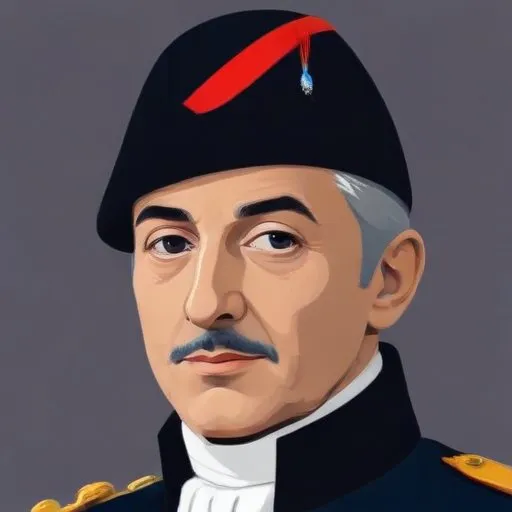
A French military leader and politician who served as Prime Minister of France during the French Revolution, known for his attempts to reform the monarchy and calm the growing unrest. He's also famous for fleeing France in disguise, only to be recognized and forced to return.
As the last chief minister of the Bourbon Monarchy, Louis Auguste Le Tonnelier de Breteuil played a pivotal role in shaping European diplomacy during the late 18th century. Appointed by King Louis XVI just 100 hours before the storming of the Bastille, Breteuil's diplomatic prowess and aristocratic connections made him a key figure in European politics.
Born on March 7, 1730, at the Château d'Azay-le-Ferron in Indre, France, Breteuil was part of a well-connected aristocratic family. His relations included a confessor to the king's cousin and the famed mathematician and linguist, Émilie, marquise du Châtelet-Laumont. Breteuil received an excellent education in Paris, which laid the foundation for his future diplomatic career.
Breteuil joined the army, where he fought in the Seven Years War, and later shifted to the French Foreign Ministry in 1758. His diplomatic skills quickly earned him recognition, and he was appointed French ambassador to the Archbishop-Elector of Cologne. In 1760, he became the French ambassador to Imperial Russia, where he navigated the complex web of European politics with ease.
In the following years, Breteuil represented France in various European capitals, including Stockholm, Vienna, and Naples. He became a favorite friend of King Gustav III of Sweden, but his relationships with other European leaders were more complicated. Catherine the Great of Russia viewed him with suspicion, while Joseph II and several high-ranking Austrian politicians saw him as impulsive and foolish.
During the riots of 1783, Breteuil, as Household Minister, decided to abolish incarceration at the Château de Vincennes, transforming it into a granary. Although this move was intended to appease the nobility, it backfired, as the public was horrified by the conditions in the oubliettes.
Breteuil's diplomatic career spanned over two decades, during which he played a significant role in shaping European politics. His connections with European monarchs and nobility gave him a unique perspective on international relations. Although his impulsive nature sometimes led to controversy, his contributions to European diplomacy cannot be denied.
In conclusion, Louis Auguste Le Tonnelier de Breteuil was a complex figure, whose diplomatic career was marked by both triumphs and controversies. His legacy serves as a reminder of the intricate web of European politics during the late 18th century, and his contributions continue to shape our understanding of diplomacy and international relations.
Born in 1710
The monarch who ruled France from 1715 to 1774, known as the "Sun King's" great-grandson, and remembered for his extravagance, absolutism, and the decline of the French monarchy.
Born in 1710
The monarch who ruled France from 1715 to 1774, known as the "Sun King's" great-grandson, and remembered for his extravagance, absolutism, and the decline of the French monarchy.
Born in 1755
The last queen of France before the French Revolution, known for her extravagance and mismanagement of the French economy, which contributed to the downfall of the monarchy.
Born in 1769
A French military leader who rose to prominence during the French Revolution and became Emperor of France, known for his military conquests and reorganization of Europe. He is also famous for his Napoleonic Code, which remains a foundation of modern law.
Born in 1754
A master diplomat and strategist who navigated the treacherous waters of French politics during the Revolution and Napoleon's rise to power, shaping European history through cunning and wit.
