


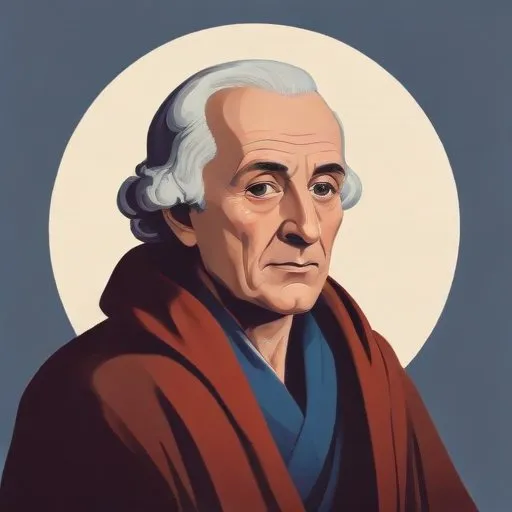
A mystic and philosopher who blended Christianity, Kabbalah, and Hermeticism to develop a unique spiritual philosophy, influencing later esoteric thinkers. His writings explored the nature of God, humanity, and the universe.
Louis Claude de SaintMartin, known as le philosophe inconnu, was a French philosopher whose influential works on mysticism, the human mind, and spiritual evolution shaped the foundation of the Martinist Order.
Born on January 18, 1743, in Amboise, France, SaintMartin hailed from a family of lesser nobility in central France. Initially, he pursued law and later joined the army, as per his father's wishes.
In 1768, while stationed in Bordeaux, SaintMartin came under the influence of Martinez de Pasqually, a Portuguese mystic who taught a blend of cabbalistic mysticism and theurgy. This encounter marked a turning point in SaintMartin's life, as he became deeply invested in Pasqually's teachings and joined the Elect Cohens, a secret society founded by Pasqually.
SaintMartin's philosophical contributions revolved around the concept of the "Inner Church," a mystical realm where individuals could connect with the divine. He believed that human beings possessed an inherent capacity for spiritual evolution, which could be achieved through introspection, self-reflection, and spiritual practices.
His works, published under the pseudonym le philosophe inconnu, explored the mysteries of the universe, the nature of the human soul, and the interconnectedness of all things. SaintMartin's writings blended elements of mysticism, theosophy, and esotericism, earning him recognition as a prominent thinker of his time.
SaintMartin's philosophical ideas have had a lasting impact on modern esoteric thought, influencing numerous mystical and spiritual movements. The Martinist Order, founded in the late 19th century, drew heavily from his teachings, and his ideas continue to inspire spiritual seekers and philosophers to this day.
In 1784, SaintMartin joined the Society of Harmony in Paris, a Masonic lodge that fostered intellectual and spiritual growth. He later traveled to England, where he met William Law, a prominent English mystic, and to Italy and Switzerland, expanding his network of like-minded individuals.
In 1788, SaintMartin met Baron Karl Gran Silfverhjelm, a Swedish mystic and nephew of Emanuel Swedenborg, further solidifying his connections within the mystical community.
SaintMartin's life and work spanned a tumultuous period in French history, from the Enlightenment to the French Revolution. Despite the chaos surrounding him, he remained dedicated to his philosophical pursuits, leaving behind a rich legacy of ideas that continue to inspire and challenge modern thinkers.
Today, Louis Claude de SaintMartin is recognized as a pioneering figure in the realm of mysticism and esotericism, his ideas woven into the fabric of modern spiritual thought.
Born in 1743
A mystic and philosopher who blended Christianity, Kabbalah, and Hermeticism to develop a unique spiritual philosophy, influencing later esoteric thinkers. His writings explored the nature of God, humanity, and the universe.
Born in 1688
A 17th-century polymath who made significant contributions to astronomy, philosophy, and theology, and is most known for his mystical writings on the nature of God and the afterlife.
Born in 1770
A German philosopher and academic who developed a comprehensive and systematic philosophy that emphasized the unity of all things and the dialectical process of thesis, antithesis, and synthesis. His ideas have had a profound impact on modern thought, influencing fields such as philosophy, politics, and art.
