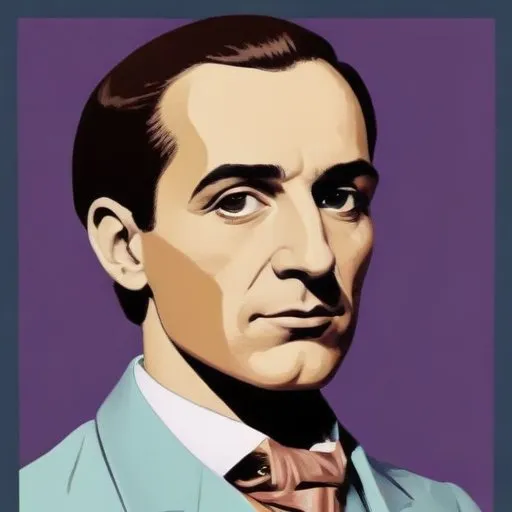
Louis-Ernest Barrias: The Romantic Realist Sculptor of the Beaux-Arts School
A Master of Marble and Beauty
Louis-Ernest Barrias, a French sculptor of the Beaux-Arts school, is renowned for his exquisite marble creations that epitomize the Romantic realist style of the late 19th century. His works, characterized by voluptuous female figures, precise attention to detail, and a sense of elegance, have left an indelible mark on the world of art.
Early Life and Training
Born on April 13, 1841, in Paris, France, Barrias was exposed to the world of art from a young age. His father, a porcelain painter, and his older brother, Félix-Joseph Barrias, a well-known painter, instilled in him a passion for creativity. Initially, Barrias pursued a career in painting, studying under Léon Cogniet. However, he soon shifted his focus to sculpture, training under Pierre-Jules Cavelier at the École Nationale Supérieure des Beaux-Arts in Paris.
Rise to Prominence
Barrias' breakthrough came in 1865 when he won the prestigious Prix de Rome, which granted him a scholarship to study at the French Academy in Rome. This opportunity allowed him to refine his skills and immerse himself in the artistic masterpieces of antiquity. Upon his return to Paris, he became involved in the decoration of the Paris Opéra and the Hôtel de la Paix on the Champs-Élysées, cementing his reputation as a talented sculptor.
Awards and Honors
Throughout his illustrious career, Barrias received numerous accolades, including:
- 1865: Prix de Rome
- 1878: Knight of the Legion of Honour
- 1881: Officer of the Legion of Honour
- 1900: Commander of the Legion of Honour
Influence and Legacy
Barrias' work was significantly influenced by the Art Nouveau style, which was prominent during the fin-de-siècle in France. His sculptures often featured voluptuous female figures, intricate details, and a sense of eroticism, characteristic of the era. Notable works include "Nature Unveiling Herself Before Science" (1899) and "Portrait of the Young Mozart."
As a professor at the École des Beaux-Arts, Barrias mentored several distinguished artists, including Josep Clar,
Charles Despiau, Henri Bouchard, Fernand Hamar, and Victor Séléguin. He also served on the Council for the National Museums from 1900 to 1903.
Personal Milestones
Barrias replaced Dumont at the Institut de France in 1884 and succeeded Cavelier as professor at the École des Beaux-Arts. He passed away on February 4, 1905, leaving behind a legacy of beauty, elegance, and artistic mastery.
Through his stunning creations, Louis-Ernest Barrias continues to inspire artists and art enthusiasts alike, reminding us of the power of beauty to transcend time and captivate the human spirit.
FAQ
What was Louis-Ernest Barrias contribution to French sculpture?
Louis-Ernest Barrias was a prominent French sculptor and academic who made significant contributions to the development of French sculpture, particularly in the fields of historical and mythological subjects.
What were Louis-Ernest Barrias most famous works?
Louis-Ernest Barrias most famous works include La Défense de Paris, a monumental sculpture commemorating the Franco-Prussian War, and Nature Unveiling Herself Before Science, a celebrated example of Neoclassical sculpture.
How did Louis-Ernest Barrias academic career influence his art?
Louis-Ernest Barrias academic career at the École des Beaux-Arts in Paris exposed him to a rigorous training in classical techniques and artistic theory, which he applied to his sculptures with great success. He was also an influential teacher, mentoring many prominent French sculptors.
What were Louis-Ernest Barrias views on art and aesthetics?
Louis-Ernest Barrias believed in the importance of classical training and the pursuit of beauty in art. He advocated for a return to traditional techniques and themes, seeing himself as a defender of French cultural heritage.
How did Louis-Ernest Barrias work influence subsequent generations of French sculptors?
Louis-Ernest Barrias work had a profound impact on subsequent generations of French sculptors, shaping the development of French sculpture in the late 19th and early 20th centuries. His emphasis on classical techniques and mythological subjects influenced many prominent artists, including Aristide Maillol and Charles Desvergnes.