


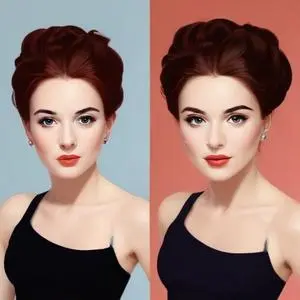
A prominent female artist of the 18th century, she was a portrait painter to European aristocracy, capturing the elegance and refinement of her subjects. Her works are celebrated for their beauty, charm, and historical significance.
Louise Élisabeth Vigée Le Brun, a renowned French painter, is best known for her exquisite portrait paintings that catapulted her to fame in the late 18th and early 19th centuries. Her remarkable talent earned her the prestigious position of portrait painter to none other than Marie Antoinette, Queen of France.
Vigée Le Brun's artistic style is a unique blend of Rococo elements with a subtle Neoclassical undertone. Her subject matter and color palette are reminiscent of the Rococo era, while her style aligns with the emerging Neoclassical movement. This distinctive approach set her apart from her contemporaries and earned her recognition as one of the greatest portraitists of her time.
Vigée Le Brun's remarkable career spanned over five decades, during which she created an astonishing 660 portraits and 200 landscapes. Her artwork is housed in prominent museums and private collections across Europe and the United States, including the Louvre in Paris, the Hermitage Museum in Saint Petersburg, and the Metropolitan Museum of Art in New York.
Vigée Le Brun's exceptional talent and charisma earned her the patronage of European aristocrats, actors, and writers. She was elected to art academies in ten cities, a testament to her widespread recognition and respect within the art community.
Her work received widespread acclaim, with notable contemporaries like Joshua Reynolds praising her as one of the greatest portraitists of her time, likening her to the old Dutch masters.
Vigée Le Brun's life was marked by a heightened sensitivity to sound, sight, and smell, which influenced her art and perspective. In her later years, between 1835 and 1837, she published her memoirs, Souvenirs, in three volumes, with the assistance of her nieces Caroline Rivière and Eugénie Tripier Le Franc. These memoirs offer valuable insights into her life, art, and experiences, as well as advice for young portraitists.
Born on April 16, 1755, in Paris, Vigée Le Brun was the daughter of Jeanne (née Maisin), a hairdresser from a peasant background, and Louis Vigée, a portraitist, pastellist, and member of the Académie de Saint-Luc.
Louise Élisabeth Vigée Le Brun's remarkable life and artistic achievements have left an indelible mark on the world of art. Her portraits continue to inspire and fascinate art enthusiasts to this day, cementing her position as one of the most celebrated portrait painters of all time.
Born in 1755
The last queen of France before the French Revolution, known for her extravagance and mismanagement of the French economy, which contributed to the downfall of the monarchy.
Born in 1769
A French military leader who rose to prominence during the French Revolution and became Emperor of France, known for his military conquests and reorganization of Europe. He is also famous for his Napoleonic Code, which remains a foundation of modern law.
Born in 1748
A French painter and illustrator who revolutionized Neoclassicism with his realistic and emotive works, creating iconic pieces like "Oath of the Horatii" and "Napoleon Crossing the Alps".
Born in 1732
A prolific Rococo painter and etcher, renowned for his delicate, whimsical, and often erotic works that capture the carefree spirit of 18th-century French aristocracy. His art often featured lush landscapes, gentle colors, and playful scenes of love and leisure.
Born in 1703
A prominent artist of the Rococo style, known for his delicate and ornate paintings, often depicting mythological and pastoral scenes, as well as designing sets for the Paris Opera.
Born in 1725
A French painter and educator renowned for his sentimental and moralizing genre scenes, often depicting young women in domestic settings, which captivated 18th-century audiences.
