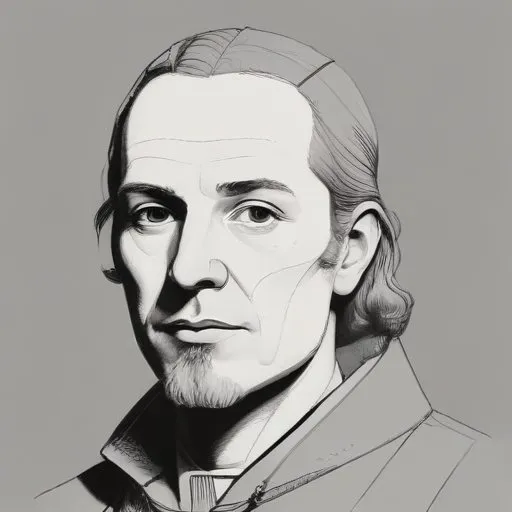
Lucas Faydherbe: The Flemish Master of High Baroque Sculpture
A Legacy of Excellence in the Southern Netherlands
Lucas Faydherbe, a Flemish sculptor and architect, was instrumental in shaping the High Baroque style in the Southern Netherlands during the 17th century. As a master of his craft, he left an indelible mark on the region's artistic landscape, creating works that continue to inspire and awe to this day.
Early Life and Training
Born on January 19, 1617, in Mechelen, Belgium, Faydherbe was the first son of Hendrik Faydherbe and Cornelia Franchoys. His family was steeped in artistic tradition, with his mother hailing from a family of painters and his father running a workshop for decorative sculpture and alabaster carving. This environment played a significant role in shaping Faydherbe's early development as an artist.
After his father's passing when he was just twelve years old, Faydherbe continued his training under the tutelage of his stepfather, Maximilian Labb, a sculptor. This apprenticeship laid the foundation for his future success.
Rubens and the Turning Point
At nineteen, Faydherbe was accepted into the prestigious workshop of
Peter Paul Rubens in Antwerp, a rare privilege considering the hundreds of applicants vying for a limited number of spots. Under Rubens' guidance, Faydherbe refined his skills, but his time in the master's workshop was cut short. He unexpectedly left to marry Maria Snyers, who was expecting his child, and was forced to abandon his plans to travel to Italy.
A Master in His Own Right
Thanks to Rubens' intercession, Faydherbe was quickly accepted as a master in the local Guild of St. Luke in Mechelen. He established himself as a skilled sculptor, working in Mechelen, Brussels, Antwerp, and Oudenaarde. His family grew to include twelve children, with his son Jan-Lucas becoming a sculptor in his own right and assisting him on various commissions.
Advocating for Artistic Excellence
Faydherbe's experiences with the local Guild of St. Luke led him to become a strong advocate for the establishment of an art academy in Mechelen, following the examples set by Brussels and Antwerp. Although his efforts were ultimately unsuccessful, they demonstrate his commitment to promoting artistic excellence and providing opportunities for future generations of artists.
A Legacy of Innovation and Beauty
Lucas Faydherbe's contributions to the development of High Baroque in the Southern Netherlands cannot be overstated. His innovative approach to sculpture and architecture, combined with his technical mastery, continue to inspire artists and art enthusiasts alike. As a testament to his enduring legacy, his works remain a vital part of the region's cultural heritage.
Major Works and Commissions
- The Tomb of Archbishop Jacob Boonen (1651) in Mechelen's St. Rumbold's Cathedral
- The High Altarpiece (1655) in the Church of Our Lady in Antwerp
- The Monument to Don Juan of Austria (1666) in the Cathedral of Our Lady in Mechelen
These works, among many others, showcase Faydherbe's skill and artistry, cementing his position as one of the most influential artists of his time.
A Lasting Impact on the Art World
Lucas Faydherbe's legacy extends beyond his impressive body of work. He played a significant role in shaping the artistic landscape of the Southern Netherlands, inspiring future generations of artists, and leaving an indelible mark on the history of art.
FAQ
What was the primary medium of Lucas Faydherbes artwork?
Lucas Faydherbe was a Flemish sculptor and architect, and his primary medium was stone, particularly marble and alabaster. He created numerous sculptures and decorative elements for buildings and monuments.
What was the style of Lucas Faydherbes architecture?
Lucas Faydherbes architecture was primarily Baroque in style, characterized by grandiose and ornate designs. He was influenced by the works of Italian architects, such as Bernini and Borromini.
Where did Lucas Faydherbe receive his training?
Lucas Faydherbe received his training in Antwerp, where he was apprenticed to the sculptor Peter Verbruggen. He later traveled to Italy to study the works of classical and Renaissance architects and sculptors.
What was Lucas Faydherbes contribution to the development of Flemish Baroque architecture?
Lucas Faydherbe was a key figure in the development of Flemish Baroque architecture, introducing Italianate styles and motifs to the region. His works showcased his mastery of ornate decoration and creative use of materials.
What is Lucas Faydherbes most famous work?
Lucas Faydherbes most famous work is the pulpit of the St. Walburga Church in Oudenaarde, Belgium. The pulpit is considered one of the finest examples of Flemish Baroque sculpture and is decorated with intricate carvings and ornate details.