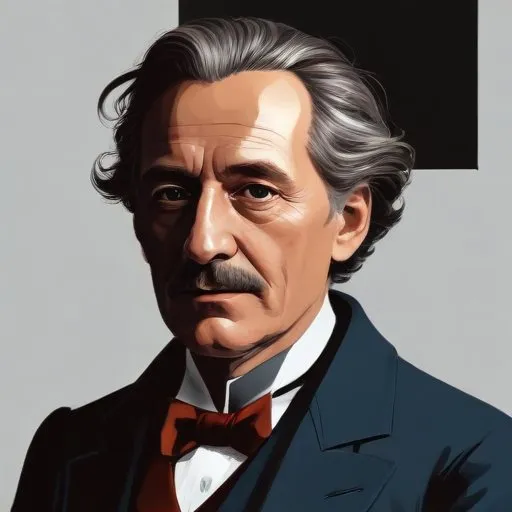
Ludwig Lange: The Pioneer of Inertial Frames of Reference
Ludwig Lange, a German physicist, is renowned for introducing the concept of inertial frames of reference and inertial time, which laid the foundation for the development of relativistic mechanics. His groundbreaking work in the late 19th century revolutionized our understanding of space and time, diverging from Sir Isaac Newton's absolute space and time theories.
Early Life and Education
Born on June 21, 1863, in Gießen, Germany, Ludwig Lange was the son of philologist and archaeologist Ludwig Lange and his wife Adelheide Blume. He pursued higher education at the University of Leipzig and the University of Gießen, studying mathematics, physics, psychology, epistemology, and ethics from 1882 to 1885. During this period, he worked as an assistant to
Wilhelm Wundt, a prominent German philosopher and psychologist.
Academic Contributions
Lange's most notable contributions came in 1885, when he published two papers: "Über die wissenschaftliche Fassung des Galileischen Beharrungsgesetzes" (On the Scientific Formulation of Galileo's Law of Inertia) and "Über das Beharrungsgesetz" (On the Law of Inertia). In these works, he introduced the concept of inertial frames of reference, which describes the motion of objects in a coordinate system. This idea was instrumental in the development of relativistic mechanics in the early 20th century.
- In 1886, Lange published "Die geschichtliche Entwicklung des Bewegungsbegriffs und ihr voraussichtliches Endergebnis" (The Historical Development of the Concept of Motion and its Probable Final Result), which further explored the concept of motion and its implications.
- In 1902, he published "Das Inertialsystem vor dem Forum der Naturforschung" (The Inertial System before the Forum of Natural Research), which reiterated the significance of inertial frames of reference in understanding the natural world.
Legacy and Impact
Lange's work on inertial frames of reference had a profound impact on the development of modern physics. His ideas influenced prominent physicists, including
Max Planck and
Albert Einstein, and paved the way for the theory of special relativity. Lange's contributions continue to be recognized and celebrated in the scientific community, with
Max von Laue, a Nobel laureate, paying tribute to Lange's work in his 1948 article.
Despite his significant contributions, Lange's life was marked by personal struggles, including a nervous disease that affected him from 1887 onwards. He spent his final years in a psychiatric hospital, where he passed away on July 12, 1936.
Through his pioneering work, Ludwig Lange left an indelible mark on the world of physics, shaping our understanding of space, time, and motion. His legacy continues to inspire scientists and scholars, ensuring his place in the annals of scientific history.
FAQ
What were Ludwig Langes contributions to physics?
Ludwig Lange was a German physicist who made significant contributions to the field of physics, particularly in the areas of electromagnetism and thermodynamics.
What was Ludwig Langes most notable research finding?
Ludwig Langes most notable research finding was his discovery of the Lange effect, a phenomenon in which the temperature of a gas is affected by the presence of electric fields.
Did Ludwig Lange have any other notable achievements?
Yes, Ludwig Lange was also a prolific writer and lecturer, and was a fellow of the German Academy of Sciences.
What is Ludwig Langes legacy in the field of physics?
Ludwig Langes legacy in the field of physics is that of a pioneering researcher who made significant contributions to our understanding of electromagnetism and thermodynamics.
What is the Lange effect?
The Lange effect is a phenomenon discovered by Ludwig Lange, in which the temperature of a gas is affected by the presence of electric fields.