


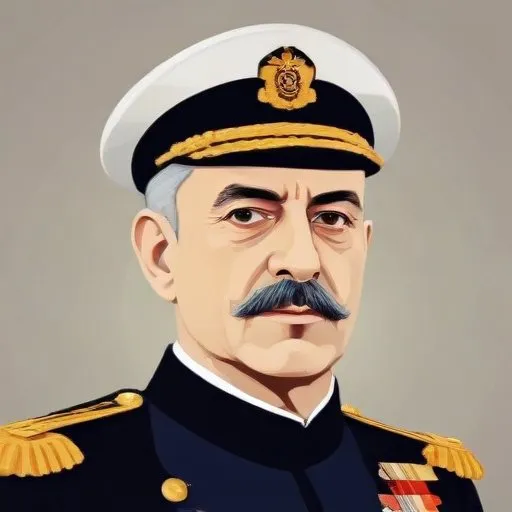
A Spanish admiral and politician who served as the 69th President of the Government of Spain, known for his close ties to dictator Francisco Franco and his role in maintaining Franco's regime. He's infamous for being assassinated by the Basque separatist group ETA in 1973.
Luis Carrero Blanco was a Spanish Navy officer and politician, best known for being the trusted confidant and right-hand man of dictator Francisco Franco. As one of the most prominent figures in the Francoist dictatorship's power structure, he served as Spain's Premier and held numerous high-ranking offices throughout his career.
Luis Carrero Blanco was born on March 4, 1904, in the coastal town of Santoña, province of Santander, Spain. He came from a military family and followed in the family tradition by enlisting at the Spanish Naval Academy in San Fernando, Cádiz, at the age of 14.
By 18, he had achieved the rank of lieutenant and served aboard the dreadnought Alfonso XIII. He participated in the Rif War from 1924 to 1926 and later specialized in submarine warfare, serving as lieutenant commander on the B2 and as commander on the B5.
Carrero Blanco's unwavering loyalty to Franco earned him a significant role in the Francoist dictatorship. He held the office of Undersecretary of the Presidency from 1941 to 1967 and later became Franco's deputy from 1967 to 1973.
He was also the main drafter behind the 1947 Law of Succession to the Headship of the State, which secured Franco's position as head of state. Franco handpicked him as his successor in the role of head of government, and Carrero Blanco took office in June 1973.
Tragically, Carrero Blanco's time as Prime Minister was short-lived. On December 20, 1973, he was assassinated in Madrid in a streetside bombing by the Basque nationalist group Euskadi Ta Askatasuna (ETA) while returning from Mass in his car.
His death sent shockwaves throughout Spain and had significant implications for the country's political landscape. Despite his controversial role in the Francoist regime, Carrero Blanco's legacy is a testament to his ability to navigate the complexities of Spanish politics during a tumultuous period in the country's history.
Carrero Blanco married María del Carmen Pichot y Villa in 1929, and the couple had several children together. Despite his demanding public life, he remained deeply committed to his family and was known for his strong Catholic faith.
"The unity of Spain is not a mere ideal, but a historical and political reality."
"The greatness of a nation is not measured by its territorial extent, but by the greatness of its spirit."
Carrero Blanco's life and career are inextricably linked with the Francoist dictatorship, a period marked by authoritarian rule, repression, and human rights abuses. However, his role as a key figure in the regime also underscores the complexities and nuances of Spanish politics during the 20th century.
Today, his legacy serves as a reminder of the importance of understanding the multifaceted nature of historical events and the people who shaped them.
Born in 1892
The authoritarian leader who ruled Spain with an iron fist from 1939 to 1975, suppressing opposition and imposing conservative values, while also modernizing the economy. He's infamous for his brutal regime and human rights abuses.
93 Years Old
The first Prime Minister of Spain after the country's transition to democracy, known for leading the country's shift from dictatorship to constitutional monarchy. He played a key role in establishing a new political system and drafting the Spanish Constitution.
Born in 1922
A Spanish politician who served as the 3rd President of the Xunta of Galicia, known for his role in shaping Galicia's autonomy and modernization. He was a key figure in Spain's transition to democracy.
73 Years Old
The Prime Minister of Spain from 1996 to 2004, known for leading the country's economic growth and membership in the European Union. He's also remembered for his support of the US-led Iraq War.
84 Years Old
The Prime Minister of Spain from 1982 to 1996, known for leading the country's transition from dictatorship to democracy and implementing significant economic and social reforms.
71 Years Old
The Prime Minister of Spain from 2011 to 2018, known for his conservative policies and leadership during the European sovereign-debt crisis. He played a key role in shaping Spain's economy and politics during a tumultuous period.
