


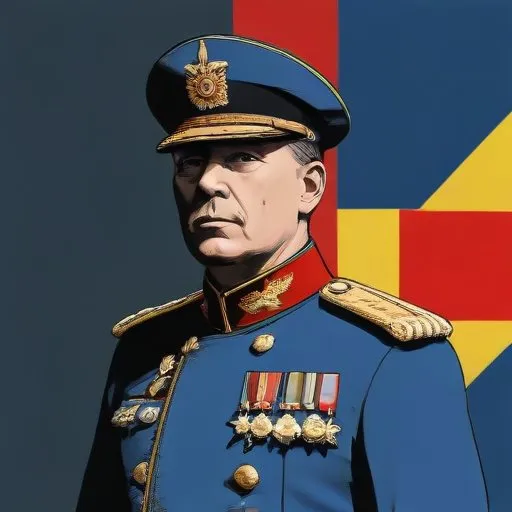
A 17th-century military leader and statesman who played a crucial role in Sweden's Great Northern War, leading troops to several victories and advising the king on state affairs.
Count Magnus Stenbock is renowned for his instrumental role in the Great Northern War, serving as a commander of the Carolean Army and earning the admiration of King Charles XII for his exceptional military prowess and administrative skills. As a Swedish field marshal and Royal Councillor, Stenbock's legacy is marked by his bravery, strategic brilliance, and unwavering dedication to his country.
Born on May 22, 1665, Magnus Stenbock came from a prominent Swedish family, the Stenbocks. He pursued his studies at Uppsala University, where he developed a strong foundation in military strategy and leadership. These formative years laid the groundwork for his future success as a military commander and administrator.
Stenbock's military career began during the Nine Years War, where he participated in the Battle of Fleurus in 1690. His remarkable performance earned him the appointment of lieutenant colonel. He later entered Holy Roman service as Adjutant General, further honing his military expertise.
Returning to Swedish service, Stenbock received colonelcy of a regiment in Wismar and later became colonel of the Kalmar and then Dalarna regiments. During the Great Northern War, he served under King Charles XII, playing a crucial role in several military campaigns in the Baltic and Polish fronts.
As director of the General War Commissariat, Stenbock demonstrated his exceptional administrative skills, collecting substantial funds and supplies for the maintenance of the Swedish army. This earned him the admiration of King Charles XII, who recognized Stenbock's invaluable contribution to the war effort.
In 1705, Stenbock was appointed general of the infantry and Governor General of Scania. During this tenure, he showcased his administrative prowess, organizing Scania's defense against an invading Danish army. In 1710, he led the Swedish army to a decisive victory against the Danes at the Battle of Helsingborg.
One of Stenbock's most notable military achievements came in 1712, when he conducted a campaign in northern Germany and defeated a Saxon-Danish army at the Battle of Gadebusch. This triumph earned him his field marshal's baton, solidifying his reputation as a brilliant military strategist.
Stenbock's career, however, took a devastating turn in 1713, when he ordered the merciless destruction of the city of Altona. This decision led to his downfall, and he was forced to surrender to King Frederick IV of Denmark during the siege of Tönning.
Imprisoned in Copenhagen, Stenbock was subjected to a defamation campaign conducted by Frederick IV. He was later transferred to Kastellet, where he endured harsh treatment until his death in 1717.
Magnus Stenbock's legacy is a testament to his unwavering dedication to his country and his exceptional military and administrative skills. Despite his tragic downfall, Stenbock remains an important figure in Swedish history, remembered for his bravery, strategic brilliance, and his instrumental role in shaping the Great Northern War.
Born in 1748
King of Sweden and Norway from 1809 to 1818, known for his role in the Finnish War and the Convention of Moss, which led to the union of Sweden and Norway.
Born in 1583
Lord High Chancellor of Sweden who played a crucial role in shaping the country's government and military during the 17th century, known for his diplomatic skills and administrative reforms.
