


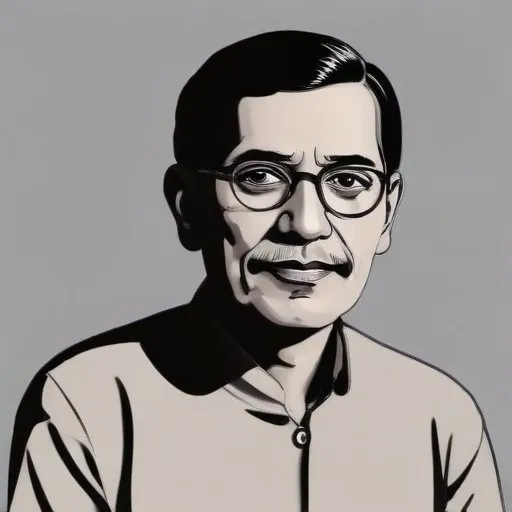
A pioneering Indian journalist, poet, and playwright who championed social reform and Indian independence through his powerful writings. His works continue to inspire generations with their patriotic fervor and literary merit.
Makhanlal Chaturvedi, a renowned Indian poet, writer, essayist, and playwright, is remembered for his significant contribution to India's national struggle for independence and his role in shaping the country's literary landscape. He is particularly celebrated for his work in the Neoromanticism movement of Hindi literature, known as Chhayavaad.
Chaturvedi's literary journey began at a young age, and he went on to become a prolific writer, producing numerous works that reinforced Indian nationalism during the British Raj. His notable works include Him Kirtini, Him Tarangini, Yug Charan, and Sahitya Devata. His poems, such as Venu Lo Gunje Dhara, Deep Se Deep Jale, Kaisa Chhand Banaa Deti hai, Agnipath, and Pushp ki Abhilaashaa, are still widely read and admired today.
Chaturvedi's contributions to Indian literature were recognized and honored with the first Sahitya Akademi Award in Hindi for his work Him Tarangini in 1955. He was also awarded the Padma Bhushan, a prestigious civilian honor, by the Government of India in 1963.
Chaturvedi was born on April 4, 1889, in Babai Makhan Nagar village, Narmadapuram district, Madhya Pradesh. From a young age, he was drawn to the national struggle for independence, and his writings reflected his strong nationalist sentiments. He became a schoolteacher at the age of 16 and later edited nationalist journals, including Prabha, Pratap, and Karmaveer. During the British Raj, he was repeatedly incarcerated for his writings, which were deemed seditious by the colonial authorities.
After India gained independence, Chaturvedi continued to write and speak out against social evils and advocate for an exploitation-free, equitable society, as envisioned by Mahatma Gandhi. In his memory, the Madhya Pradesh Sahitya Akademi and the Madhya Pradesh Cultural Council organize the annual Makhanlal Chaturvedi Samaroh, which has been held since 1987. The event also includes the awarding of the annual Makhanlal Chaturvedi Award to recognize outstanding contributions to Hindi literature.
Chaturvedi's works and ideology have had a lasting impact on modern Indian society. His poetry and writings continue to inspire generations of Indians, and his contribution to the country's national struggle for independence has been recognized and revered. His legacy serves as a reminder of the power of literature and the importance of standing up against social injustice.
Chaturvedi's philosophy was deeply rooted in Indian nationalism and the struggle for independence. He believed in the power of literature to inspire and mobilize people to work towards a common goal. His writings reflected his strong sense of social justice and his commitment to creating a more equitable society.
Makhanlal Chaturvedi's life and works serve as a testament to the power of literature and the importance of standing up against social injustice. His legacy continues to inspire generations of Indians, and his contributions to Indian literature remain unparalleled.
Born in 1861
A Bengali polymath who wrote extensively on love, nature, and humanity, creating a unique blend of Indian and Western literary styles, and was the first non-European to win the Nobel Prize in Literature.
Born in 1869
Indian freedom fighter, activist, and philosopher who led India to independence from British rule through non-violent civil disobedience, inspiring civil rights movements worldwide.
Born in 1889
India's first Prime Minister, a key figure in the country's struggle for independence from British rule, and a champion of democracy and secularism. He played a crucial role in shaping modern India's government and economy.
Born in 1897
Indian freedom fighter and politician who led the Indian National Army against British rule and was a key figure in the country's struggle for independence. He is also known for his mysterious disappearance in 1945.
Born in 1879
A pioneering Indian poet and activist who used her lyrical voice to advocate for women's rights and Indian independence, leaving a lasting legacy in Indian literature and politics.
Born in 1890
A pioneering figure in the Indian independence movement, he advocated for non-violent resistance and unity among Muslims and Hindus. He's known for his tireless efforts to promote peace and social justice.
Born in 1878
The first Indian Governor-General of India, serving from 1948 to 1950, and a key figure in the country's struggle for independence from British rule. He was a strong advocate for non-violent resistance and played a crucial role in shaping India's early years.
