


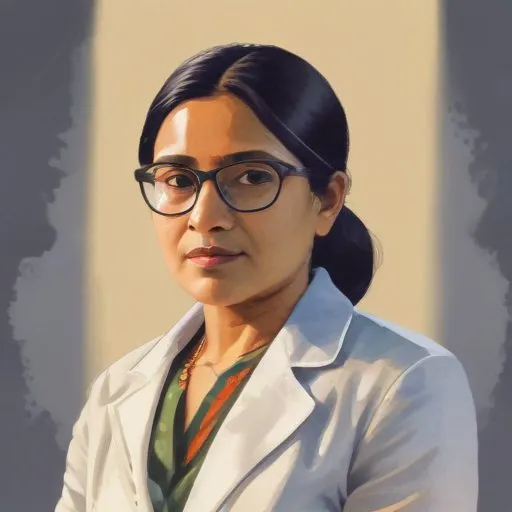
A renowned Indian biologist and academic who made significant contributions to the field of molecular biology, particularly in the areas of genomics and bioinformatics.
Manju Bansal is a renowned Indian molecular biophysicist known for her groundbreaking contributions to the field of molecular biophysics, particularly in the area of theoretical modeling of biomolecular structures. Currently, she is a professor in the theoretical biophysics group at the Indian Institute of Science, Bangalore, and the founder director of the Institute of Bioinformatics and Applied Biotechnology in Bangalore.
Born on December 1, 1950, Manju Bansal developed an early interest in science, which led her to pursue a BSc and MSc from Osmania University, Hyderabad. She then joined the Molecular Biophysics Unit at the Indian Institute of Science, Bangalore, where she earned her PhD in 1977 under the guidance of biophysicist G. N. Ramachandran, working on the theoretical modeling of the triple helical structure of the fibrous protein collagen.
After completing her PhD, Bansal continued to work at IISc as a postdoctoral fellow, focusing on left-handed and other unusual structures of DNA until 1981. She then received an Alexander von Humboldt Fellowship to work at the European Molecular Biology Laboratory in Heidelberg, Germany, where she worked on the structure of filamentous phages. Her research has also taken her to the United States, where she was a Visiting Professor at Rutgers University and a Visiting Consultant at NIH, Bethesda.
Bansal's contributions to the field of molecular biophysics have been recognized with several prestigious awards and honors. She was awarded the INSA Medal for Young Scientists in 1979 and is a Fellow of the Indian Academy of Sciences, Bangalore, and the National Academy of Sciences, India, since 1998. She has also received an EMBL Visiting Fellowship, AvH Fellowship, Germany, and a Senior Fulbright Fellowship, USA.
Bansal's work is guided by a deep understanding of the importance of theoretical modeling in understanding biomolecular structures. She believes that a strong foundation in theoretical biophysics is essential for advancing our understanding of biological systems and developing new therapeutic strategies. Her work has inspired a new generation of researchers to explore the intersection of physics, chemistry, and biology.
Manju Bansal's work has far-reaching implications for our understanding of biological systems and has the potential to impact the development of new therapeutic strategies. Her contributions to the field of molecular biophysics have paved the way for further research in this area, which could lead to breakthroughs in the treatment of diseases such as cancer and genetic disorders.
Bansal's journey as a molecular biophysicist has been marked by several personal milestones, including her decision to pursue a career in science despite the challenges faced by women in the field at the time. Her determination and perseverance have inspired countless young researchers, particularly women, to pursue careers in science.
While Bansal's work may not have directly influenced popular culture, her contributions to the field of molecular biophysics have the potential to inspire new generations of scientists and researchers, who may go on to make groundbreaking discoveries that impact our daily lives.
Manju Bansal's legacy as a pioneering molecular biophysicist will continue to inspire and motivate future generations of researchers. Her contributions to the field of molecular biophysics have paved the way for further research and discovery, which could lead to breakthroughs in our understanding of biological systems and the development of new therapeutic strategies.
Born in 1920
A British scientist who contributed significantly to the discovery of the structure of DNA, providing high-quality X-ray crystallography images that helped James Watson and Francis Crick develop their famous model.
98 Years Old
Discovered the structure of DNA, revolutionizing our understanding of genetics and earning a Nobel Prize. Pioneering work in molecular biology has far-reaching implications for medicine and beyond.
Born in 1916
Pioneering scientist who discovered the structure of DNA, revolutionizing our understanding of genetics and life itself.
Born in 1901
Pioneering chemist and peace activist who won two unshared Nobel Prizes, one for chemistry and one for peace, for his groundbreaking work on the nature of the chemical bond and his tireless efforts to promote nuclear disarmament.
81 Years Old
Developed the polymerase chain reaction (PCR) technique, a groundbreaking method for amplifying DNA sequences, revolutionizing genetics and molecular biology research.
80 Years Old
Pioneering geneticist who sequenced the human genome and created the first self-replicating synthetic cell, revolutionizing our understanding of life and its potential. 82
76 Years Old
Led the Human Genome Project, decoding human DNA and paving the way for genetic medicine. Currently directs the National Institutes of Health, shaping biomedical research and policy.
