


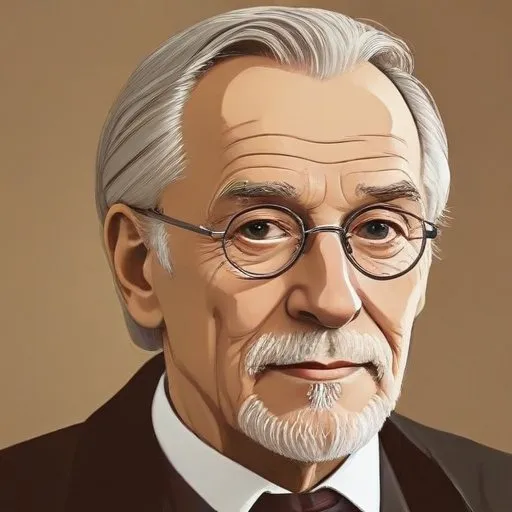
A Swedish physicist who pioneered X-ray spectroscopy, leading to significant advancements in understanding atomic structure and earning a Nobel Prize in Physics.
Manne Siegbahn, a Swedish physicist, revolutionized the field of X-ray spectroscopy, earning him the Nobel Prize in Physics in 1924. His groundbreaking research and discoveries in this field have had a lasting impact on our understanding of the atomic structure and the behavior of electrons.
Born on December 3, 1886, in Örebro, Sweden, Manne Siegbahn was the son of Georg Siegbahn and Emma Zetterberg. He pursued his education in Stockholm, graduating in 1906, and later began his studies at Lund University in the same year. During his time at Lund, he worked as a secretarial assistant to the renowned physicist Johannes Rydberg.
Siegbahn's academic career was marked by several milestones. In 1908, he studied at the University of Göttingen, and in 1911, he obtained his doctorate (PhD) from Lund University. His thesis, titled "Magnetische Feldmessungen" (Magnetic Field Measurements), laid the foundation for his future research in X-ray spectroscopy.
In 1914, Siegbahn began his research on X-ray spectroscopy, initially using the same type of spectrometer as Henry Moseley. However, he soon developed improved experimental apparatus, allowing him to make very accurate measurements of X-ray wavelengths produced by atoms of different elements.
Siegbahn's innovative approach led to several significant breakthroughs. He discovered that several of the spectral lines found by Moseley consisted of more components, and by studying these components, he gained an almost complete understanding of the electron shell. This understanding enabled him to develop a convention for naming the different spectral lines that an atom can emit.
His work in X-ray spectroscopy paved the way for the development of new technologies, including X-ray fluorescence and X-ray absorption spectroscopy. These techniques have since become essential tools in various fields, such as materials science, chemistry, and biology.
In 1937, Siegbahn was appointed Director of the Physics Department of the Nobel Institute of the Royal Swedish Academy of Sciences. In 1988, this institute was renamed the Manne Siegbahn Institute (MSI) in his honor. Today, the Manne Siegbahn Laboratory, hosted by Stockholm University, continues to carry on his legacy in the field of physics.
Siegbahn's contributions to science have had a lasting impact on our understanding of the atomic structure and the behavior of electrons. His pioneering work in X-ray spectroscopy has paved the way for numerous breakthroughs in various fields, solidifying his place as one of the most influential physicists of the 20th century.
Manne Siegbahn's achievements were recognized with several prestigious awards and honors, including:
Through his groundbreaking research and discoveries, Manne Siegbahn has left an indelible mark on the world of physics, inspiring future generations of scientists to continue exploring the mysteries of the atomic structure.
Born in 1885
A pioneer in quantum mechanics, he introduced the concept of wave-particle duality, revolutionizing our understanding of atomic structure. His philosophical approach to science also explored the nature of reality and human understanding.
Born in 1901
A pioneer in quantum mechanics, he formulated the uncertainty principle, which revolutionized our understanding of the atomic world. His groundbreaking work reshaped modern physics.
Born in 1879
A brilliant physicist who developed the theory of relativity and is considered one of the most influential scientists of the 20th century, known for his groundbreaking work in physics and mathematics.
Born in 1867
A pioneering scientist who pioneered radioactivity research, discovering elements polonium and radium, and paving the way for breakthroughs in medicine and energy.
Born in 1859
A pioneer in radioactivity research, discovering elements like polonium and radium, and pioneering radioactive isolation techniques. Their groundbreaking work paved the way for advancements in medicine, energy, and materials science.
Born in 1852
Discovered radioactivity, a fundamental property of atoms, and pioneered research in the field, leading to breakthroughs in medicine, energy, and materials science.
Born in 1871
A pioneer in nuclear physics, he discovered the nucleus of an atom and developed the Rutherford model, revolutionizing our understanding of the atomic structure.
