


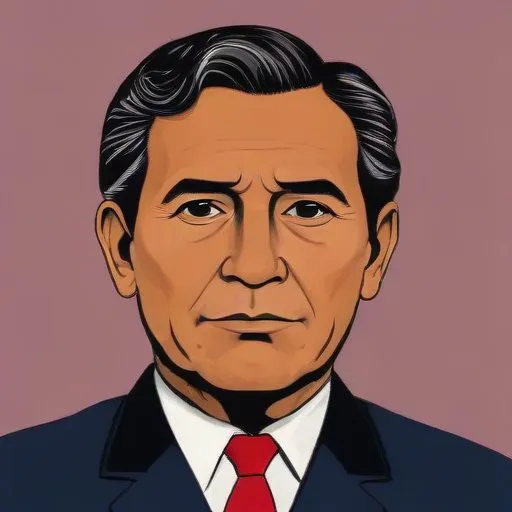
Peru's 57th president, a lawyer and politician, served from 1966 to 1968 and is known for his brief but significant tenure during a time of military coups and political unrest. He implemented several reforms, including land redistribution and labor rights.
Manuel Mara Ponce Brousset is best known for his brief but significant stint as the President of Peru, serving as the interim head of state for a mere two days in August 1930. During this time, he played a crucial role in transitioning power from the ousted Augusto B. Leguia to Luis Miguel Snchez Cerro, marking a pivotal moment in Peru's political history.
Brousset was born on April 5, 1874, in Arequipa, Peru, and grew up to become a prominent figure in Peruvian politics. Before his presidency, he held various positions in the government, including serving as a congressman and a minister.
In August 1930, a coup d'etat led by Luis Miguel Snchez Cerro overthrew the eleven-year dictatorship of Augusto B. Leguia. As Snchez Cerro made his way to Lima, Ponce assumed the presidency, effectively becoming the caretaker of the government. His brief tenure was marked by a peaceful transition of power, as he handed over the reins to Snchez Cerro upon his arrival.
Although Ponce's presidency was short-lived, his role in facilitating a smooth transition earned him recognition and respect. He continued to serve in various capacities in the Peruvian government, earning a reputation as a statesman and a unifying figure. Ponce passed away on July 18, 1966, at the age of 92, leaving behind a legacy of service and dedication to his country.
Ponce's presidency came at a time of great upheaval in Peru, with the country emerging from a long period of authoritarian rule. His brief tenure marked a turning point in the country's history, as it paved the way for a new era of democratic governance. While his presidency was short, his impact on Peruvian politics was significant, earning him a place in the country's history books.
Manuel Mara Ponce Brousset's life and legacy serve as a testament to his commitment to public service and his role in shaping Peru's political history. While his presidency may have been brief, his impact continues to resonate to this day.
77 Years Old
The first democratically elected president of Peru to serve two non-consecutive terms, known for implementing neoliberal economic policies and facing corruption allegations.
88 Years Old
Peruvian engineer, academic, and politician who served as the 90th President of Peru, known for his authoritarian rule and controversial policies, including forced sterilizations and human rights abuses.
80 Years Old
Peruvian economist and politician who served as President of Peru from 2001 to 2006, known for implementing economic reforms and promoting social programs. He's also recognized for his indigenous roots and advocacy for Andean communities.
88 Years Old
A Peruvian entrepreneur and politician who served as the 66th President of Peru, known for his economic reforms and efforts to combat corruption. He was also a World Bank economist and a Wall Street investment banker.
63 Years Old
The 67th President of Peru, an engineer-turned-politician, is known for his anti-corruption efforts and reforms, particularly in the judiciary and education systems. He's also recognized for his handling of the COVID-19 pandemic in Peru.
90 Years Old
The first democratically elected president of Peru after a decade of authoritarian rule, known for stabilizing the country's economy and politics. He played a key role in Peru's transition to democracy.
Born in 1910
Led a left-wing military coup, implementing radical reforms and nationalizing key industries, earning a reputation as a champion of the poor and a thorn in the side of foreign corporations.
