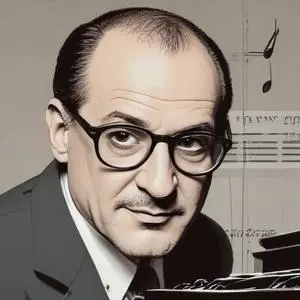
Marc Blitzstein: The Maverick Composer Who Rocked the Cradle
A Musical Trailblazer
Marc Blitzstein, an American composer, lyricist, and librettist, shot to national prominence in 1937 with his provocative musical,
The Cradle Will Rock, directed by
Orson Welles. This was no ordinary musical – it was a scathing critique of capitalism, and its shutdown by the Works Progress Administration sparked a controversy that cemented Blitzstein's reputation as a bold and unapologetic artist.
Early Life and Training
Born on March 2, 1905, in Philadelphia to affluent parents, Blitzstein's musical talents were evident from a young age. He began performing Mozart piano concertos at the tender age of seven and went on to study piano with Alexander Siloti, a pupil of Tchaikovsky and Liszt. Blitzstein's professional concerto debut with the Philadelphia Orchestra in Liszt's E-flat Piano Concerto came when he was just 21. He later honed his composition skills at the Curtis Institute of Music and in Europe, where he studied with
Arnold Schoenberg in Berlin and
Nadia Boulanger in Paris.
A Legacy of Provocation and Innovation
Blitzstein's oeuvre is a testament to his fearless approach to art. His opera,
Regina, an adaptation of
Lillian Hellman's play
The Little Foxes, showcased his mastery of complex characters and social commentary. His off-Broadway translation-adaptation of
The Threepenny Opera, by
Bertolt Brecht and
Kurt Weill, further solidified his reputation as a master translator and adapter. Other notable works include the Broadway musical
Juno, based on Sean O'Casey's play
Juno and the Paycock, and
No for an Answer, a searing critique of fascism.
Controversy and Critique
Blitzstein's unflinching commitment to social commentary and critique often landed him in controversy. His left-wing politics and outspoken views on capitalism, fascism, and the arts made him a target for criticism. However, he remained resolute in his artistic vision, consistently pushing the boundaries of what was deemed acceptable.
Influence and Legacy
Blitzstein's impact on modern music is undeniable. His innovative approach to musical theater paved the way for future generations of composers and lyricists. His collaborations with Bertolt Brecht and Kurt Weill introduced American audiences to the German avant-garde, influencing the development of musical theater.
Personal Milestones and Quotes
- Blitzstein's personal life was marked by turmoil, including a tumultuous relationship with his partner, Evan Thomas.
- He was known for his wit and humor, often incorporating humor into his musical works.
- "I'm not interested in doing something that doesn't have a social significance," Blitzstein once said, encapsulating his artistic philosophy.
Awards and Honors
Blitzstein received numerous awards and accolades for his contributions to music, including the New York Drama Critics' Circle Award for Best Musical for
The Cradle Will Rock.
Conclusion
Marc Blitzstein's life and work serve as a testament to the power of art to challenge and subvert. His fearlessness, innovative spirit, and commitment to social commentary have left an indelible mark on the world of music and beyond. As a true original, Blitzstein's legacy continues to inspire and provoke, ensuring his place as one of the most important figures in American musical theater.
FAQ
What is Marc Blitzstein known for in music?
Marc Blitzstein is known for his contributions to American opera and musical theatre, particularly his work on The Cradle Will Rock and Regina. He was a pioneer of American opera and a leading figure of the American musical theatre.
What was Marc Blitzsteins early life like?
Marc Blitzstein was born into a wealthy family in Philadelphia and showed early talent in music. He studied at the Curtis Institute of Music and later at Harvard University, where he was influenced by modernist composers.
How did Marc Blitzsteins work reflect his social views?
Marc Blitzsteins work often reflected his left-wing social views, addressing issues such as labor rights, social justice, and anti-fascism. His opera The Cradle Will Rock was famously shut down by the government due to its radical content.
What collaborations did Marc Blitzstein have with famous artists?
Marc Blitzstein collaborated with famous artists such as Orson Welles, John Houseman, and Lotte Lenya, with whom he worked on The Cradle Will Rock and Regina.
How did Marc Blitzsteins life end tragically?
Marc Blitzsteins life ended tragically in 1964 when he was murdered in Martinique by three sailors he had picked up in a bar. His death was met with shock and outrage in the artistic community.