


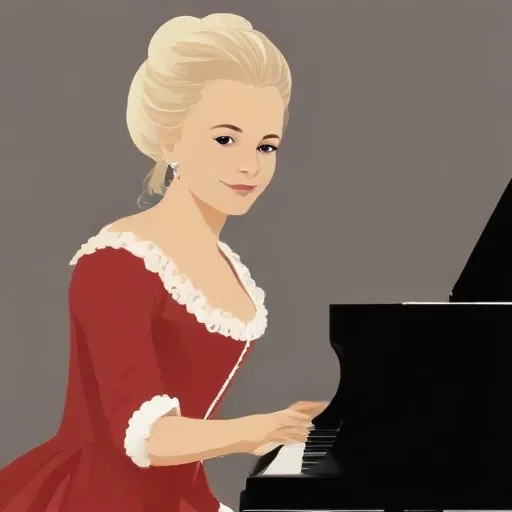
Austrian pianist and composer, known for being the sister of Wolfgang Amadeus Mozart and a child prodigy in her own right, with compositions and performances that showcased her talent.
Maria Anna Mozart, affectionately known as Nannerl, was a child prodigy and sister of the renowned composer Wolfgang Amadeus Mozart. Born on July 30, 1751, in Salzburg, Austria, she was a talented musician and composer in her own right, whose early promise was tragically cut short by the societal norms of her time.
Maria Anna was born into a family of musicians. Her father, Leopold Mozart, was a composer and music teacher who recognized her talent at an early age. He began teaching her to play the harpsichord when she was just seven years old. Her brother Wolfgang, three years her junior, would often join in on their practice sessions, and soon the siblings were performing together in public.
Between 1762 and 1769, Maria Anna and Wolfgang toured Europe, performing in major cities like Vienna, Paris, and Munich. During this time, Maria Anna received top billing, and critics praised her as an exceptional harpsichordist and fortepianist. Her talent and charm captivated audiences, earning her the nickname "the little Mozart."
As Maria Anna approached marriageable age, her father's ambition for her shifted from music to matrimony. In 1769, Leopold Mozart stopped taking her on tour, deeming it inappropriate for a young woman of her stature to continue performing in public. This decision marked the beginning of the end of Maria Anna's performing career, as she was relegated to teaching piano lessons in Salzburg to supplement her father's income.
Although Maria Anna's compositions have not survived, letters from Wolfgang reveal that she wrote music and that he praised her work. Her father's correspondence, however, makes no mention of her compositions. Despite this, her influence on her brother's early development is undeniable, and her own talent and contributions to the Mozart family's musical legacy should not be overlooked.
Maria Anna remained close to her father and brother throughout her life. She married Franz d'Ippold, a captain and private tutor, in 1783, and the couple had three children. Unlike Wolfgang, who quarreled with their father over his career choices, Maria Anna remained loyal and supportive of her family.
Maria Anna Mozart's story is a poignant reminder of the societal constraints that limited women's opportunities in the 18th century. Despite her remarkable talent, she was denied the chance to fulfill her musical potential. Nevertheless, her legacy serves as an inspiration to women in music and beyond, and her contribution to the Mozart family's rich cultural heritage endures.
Maria Anna Mozart's remarkable story serves as a testament to the power of talent, dedication, and perseverance, even in the face of adversity.
Born in 1756
A child prodigy and master of classical music, he composed over 600 works, including symphonies, operas, and chamber music, that continue to inspire and influence musicians today.
Born in 1719
A renowned 18th-century musician, composer, and conductor, known for his influential violin instruction book and being the father of Wolfgang Amadeus Mozart.
Born in 1770
A musical genius who expanded the possibilities of classical music, creating iconic symphonies and piano sonatas that continue to inspire and influence generations of artists.
Born in 1833
A renowned pianist and composer, he crafted complex, expressive works that blended traditional and innovative techniques, leaving an indelible mark on classical music.
Born in 1811
A virtuosic pianist and composer who revolutionized classical music with his technically demanding and emotionally expressive works, blending Hungarian folk influences with Romantic-era drama.
Born in 1750
A renowned 18th-century composer and conductor, known for his operas and rivalry with Mozart, as depicted in the movie Amadeus.
Born in 1714
A pioneering opera composer who revolutionized the art form with his innovative and expressive works, blending music and drama in a way that captivated audiences.
