


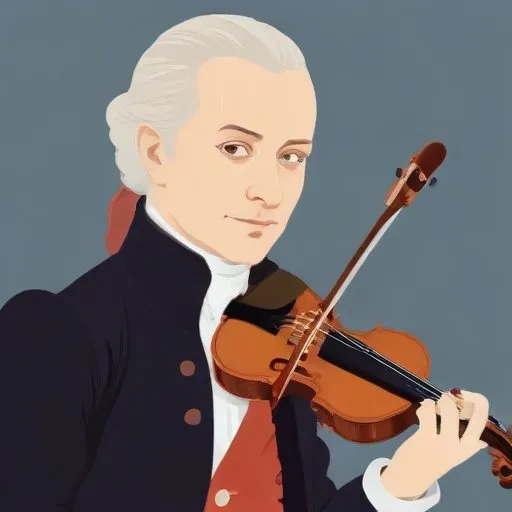
A renowned 18th-century musician, composer, and conductor, known for his influential violin instruction book and being the father of Wolfgang Amadeus Mozart.
Leopold Mozart, a German composer, violinist, and music theorist, is best known today as the father and teacher of the musical prodigy Wolfgang Amadeus Mozart. His own musical contributions, however, are often overshadowed by the towering genius of his son. Nevertheless, Leopold's influence on Wolfgang's development and his own achievements in the world of music are undeniable.
Born on November 14, 1719, in Augsburg, Germany, Leopold Mozart was the son of Johann Georg Mozart, a bookbinder, and his second wife, Anna Maria Sulzer. From a young age, Leopold demonstrated a keen interest in music, singing as a choirboy and learning to play the violin. He attended a local Jesuit school, St. Salvator, where he studied logic, science, and theology, graduating magna cum laude in 1735.
Leopold's passion for music only grew stronger as he pursued higher education. He moved to Salzburg to study philosophy and jurisprudence at the Benedictine University (now University of Salzburg). Although he was expelled from the university in 1739 for poor attendance, his love for music prevailed. In 1740, he began his career as a professional musician, teaching and performing in Salzburg.
In 1756, Leopold published his seminal work, Versuch einer gründlichen Violinschule, a comprehensive violin textbook that would shape the technique of violinists for generations to come. This treatise remains a testament to Leopold's expertise as a violinist and music theorist.
Leopold's most significant contribution to music lies in his role as a father and teacher to Wolfgang Amadeus Mozart. He recognized his son's exceptional talent from an early age and dedicated himself to nurturing and guiding Wolfgang's development. Leopold's intense tutelage and encouragement instilled in Wolfgang the discipline and skills that would propel him to greatness.
Throughout his life, Leopold Mozart remained devoted to his family and his craft. He served as a court musician in Salzburg, composed music for various occasions, and continued to teach and perform. His later years were marked by a decline in his health, but his love for music never wavered. Leopold Mozart passed away on May 28, 1787, leaving behind a rich legacy as a musician, teacher, and father to one of the greatest composers in history.
Leopold Mozart's contributions to music and his role in shaping Wolfgang Amadeus Mozart's genius continue to inspire generations of musicians and music lovers alike. His Versuch einer gründlichen Violinschule remains a vital resource for violinists, and his legacy as a father and teacher serves as a testament to the power of dedication and nurturing in the development of exceptional talent.
These works, though overshadowed by Wolfgang's masterpieces, demonstrate Leopold's skill as a composer and his commitment to the art form.
Leopold Mozart's life was a testament to the power of dedication, hard work, and a passion for music. Though often overshadowed by his son's genius, Leopold's own contributions to the world of music remain significant and enduring.
Born in 1756
A child prodigy and master of classical music, he composed over 600 works, including symphonies, operas, and chamber music, that continue to inspire and influence musicians today.
Born in 1735
A renowned Baroque composer and viol player, known for his innovative and expressive works that blended German and Italian styles. He was a prominent figure in London's musical scene during the 18th century.
Born in 1714
A renowned 18th-century musician, he was a prolific composer and virtuosic performer, known for his expressive and innovative keyboard music that bridged the Baroque and Classical styles. His compositions, particularly for harpsichord and piano, showcased his mastery of counterpoint and harmony.
Born in 1732
A renowned composer and pianist of the Classical period, known for his symphonies, operas, and chamber music that showcased his innovative and expressive style. He played a significant role in shaping the Classical music era.
Born in 1714
A pioneering opera composer who revolutionized the art form with his innovative and expressive works, blending music and drama in a way that captivated audiences.
Born in 1782
A virtuosic violinist and composer who revolutionized the instrument's technical possibilities, leaving an indelible mark on classical music.
Born in 1811
A virtuosic pianist and composer who revolutionized classical music with his technically demanding and emotionally expressive works, blending Hungarian folk influences with Romantic-era drama.
Born in 1678
A virtuosic violinist and prolific composer, he crafted over 400 concertos, including "The Four Seasons," which remains a beloved and iconic masterpiece of classical music.
