


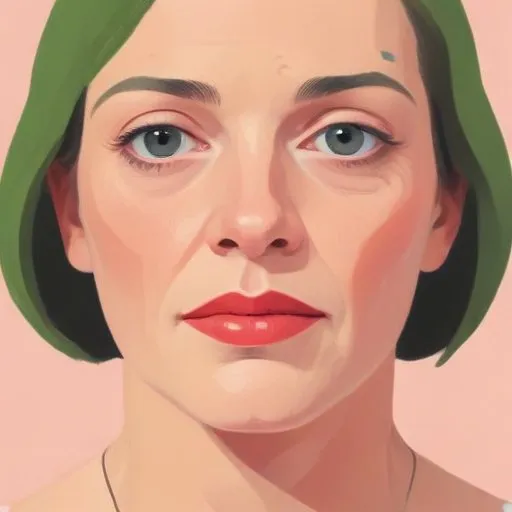
Austrian painter and academic known for pioneering a style of self-portraiture that explores the relationship between the body and psyche, often depicting herself in fantastical and distorted forms.
Maria Lassnig is renowned for her striking self-portraits and her groundbreaking theory of body awareness, which revolutionized the art world with its unique approach to representing the human body. As the first female artist to win the Grand Austrian State Prize in 1988, Lassnig's contributions to modern art are undeniable.
Born on September 8, 1919, in Kappel am Krappfeld, Austria, Maria Lassnig's early life was marked by her mother's out-of-wedlock pregnancy and subsequent marriage to a much older man. Raised primarily by her grandmother, Lassnig's tumultuous childhood influenced her artistic perspective. During World War II, she attended the Academy of Fine Arts in Vienna, where she developed her artistic skills.
Lassnig is credited with introducing Informalism and Tachisme to post-war Austrian art, paving the way for a new era of artistic expression. As a member of the Hundsgruppe (Dog Pack) group, which included notable artists like Arnulf Rainer and Ernst Fuchs, Lassnig was part of a collective that challenged traditional art forms.
In the 1950s, Lassnig's artistic focus shifted towards body awareness, a concept she coined as "Krpergefhlmalerei" (body consciousness painting). This innovative approach involved depicting only the parts of her body that she physically felt while creating, resulting in striking self-portraits that were both intimate and abstract.
Lassnig's painting "Expressive Self-Portrait" (1945) is a seminal work that showcases her unique style and artistic vision. Her participation in the "Junge unifigurative Malerei" exhibition at the Krnten Art Association in 1951, alongside Arnulf Rainer, brought her work to a wider audience. Lassnig's artistic journey took her to Paris, where she interacted with surrealist artist Andr Breton and poets Paul Celan and Benjamin Peret.
In recognition of her outstanding contributions to art, Lassnig was awarded the Grand Austrian State Prize in 1988, becoming the first female artist to receive this prestigious honor. She was also awarded the Austrian Decoration for Science and Art in 2005, a testament to her enduring impact on the art world.
Maria Lassnig's trailblazing career and artistic philosophy have inspired generations of artists, challenging conventional representations of the human body and encouraging a more introspective approach to art-making. Her work continues to fascinate audiences, inviting viewers to explore the intersection of art, body, and consciousness.
"I only paint what I feel, not what I see." - Maria Lassnig
Lassnig lived and taught in Vienna from 1980 until her passing on May 6, 2014. Her remarkable life, marked by artistic innovation and personal resilience, serves as a testament to her indomitable spirit and creative genius.
Maria Lassnig's groundbreaking theory of body awareness, coupled with her striking self-portraits, has left an indelible mark on modern art. As an artist, philosopher, and educator, her contributions continue to inspire and challenge the art world, ensuring her legacy as a pioneering figure in the history of art.
Born in 1890
Austrian soldier and painter who captured the intensity of human emotion through bold, expressive portraits and landscapes, often exploring themes of death, sexuality, and the human condition.
Born in 1886
Austrian-Swiss artist who pioneered Expressionism through vibrant, emotive paintings and plays that explored the human condition. His works often featured distorted forms and bold colors.
Born in 1862
Austrian Symbolist master of opulent, gold-leaf adorned paintings and illustrations that explored the human form, often with erotic undertones. His works are synonymous with Viennese Art Nouveau.
Born in 1880
A German soldier-turned-painter who pioneered Expressionism, capturing the emotional essence of animals and landscapes in vibrant, abstracted forms. His work continues to inspire artists and art lovers alike.
Born in 1887
A pioneering expressionist painter who captured the vibrant spirit of early 20th-century Europe through bold, colorful works that blended Fauvism and Cubism. His innovative style continues to inspire artists today.
Born in 1864
A Russian-German painter who pioneered Expressionism, capturing intense emotions through vibrant, distorted forms and bold colors. He's famous for his bold, avant-garde portraits.
Born in 1866
A pioneer of abstract art, creating vibrant, expressive works that explored the emotional and spiritual properties of color, and wrote extensively on art theory.
Born in 1879
A Swiss-German artist and educator who blended fantasy and reality in his vibrant, whimsical paintings, exploring the emotional and expressive qualities of color. His unique style has inspired generations of artists.
