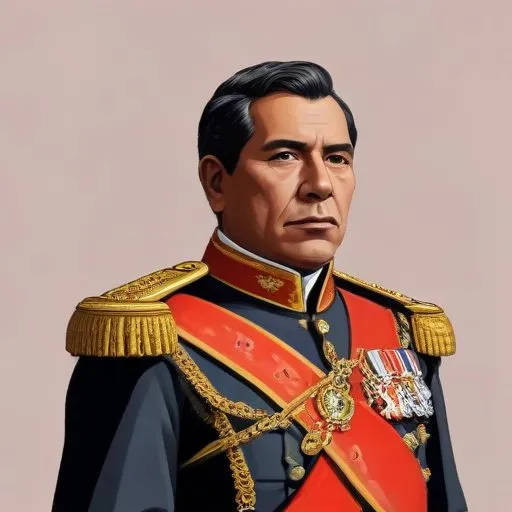
Mariano Ignacio Prado: The Unyielding Leader of Peru
A President of Unwavering Resolve
Mariano Ignacio Prado is renowned for his unwavering leadership as the 17th and 21st President of Peru, a tenure marked by a fierce determination to defend his country against foreign threats. He is celebrated for his pivotal role in the Battle of Dos de Mayo, where he led the Peruvian forces to victory against the Spanish fleet in 1866.
Early Life and Military Career
Born on December 18, 1825, in Huánuco, Peru, Prado's early life was marked by a strong sense of duty and patriotism. He joined the army at a young age and served in the provinces of Southern Peru, where he developed his military skills and strategic thinking.
Rise to Power
In 1865, Prado led a coup against President Juan Antonio Pezet, who had surrendered sovereignty over the Chincha Islands to Spain and agreed to pay a large indemnity. This bold move earned Prado the support of the Peruvian people, and he was subsequently elected as the President of Peru in 1865.
Battle of Dos de Mayo
One of Prado's most notable achievements was his victory at the Battle of Dos de Mayo in 1866. The Spanish fleet, attempting to assert its dominance over the region, was defeated by the Peruvian forces under Prado's command. This triumph not only secured Peru's sovereignty but also earned Prado the honorary title of General of the Army of Chile.
Alliance and Diplomacy
Prado's leadership was marked by his ability to forge alliances and negotiate with other nations. He formed a coalition with Chile, Bolivia, and Ecuador, which collectively defeated Spain and secured Peru's independence. This diplomatic prowess earned him respect and admiration from his contemporaries.
Second Term and the War of the Pacific
Prado's second term as President, from 1876 to 1879, was marked by the outbreak of the War of the Pacific with Chile. Despite facing significant challenges, Prado took active command of the defenses of Tacna and Tarapacá, demonstrating his unwavering commitment to his country.
Legacy
Mariano Ignacio Prado's legacy is one of unwavering determination, strategic leadership, and unwavering commitment to his country. His military victories, diplomatic prowess, and unrelenting spirit have cemented his place as one of Peru's most revered leaders.
Personal Milestones
- Born on December 18, 1825, in Huánuco, Peru
- Studied in Huánuco and Lima
- Joined the army at a young age
- Led a coup against President Juan Antonio Pezet in 1865
- Elected as the President of Peru in 1865 and 1876
- Victorious at the Battle of Dos de Mayo in 1866
- Served as the President of the Chamber of Deputies from 1874 to 1875
Influence on Modern Society
Prado's legacy extends beyond his military victories and diplomatic achievements. His unwavering commitment to his country has inspired generations of Peruvians to stand up for their rights and defend their sovereignty. His leadership has also served as a model for other Latin American countries, demonstrating the importance of strong, nationalistic leadership in the face of foreign threats.
FAQ
What were Mariano Ignacio Prados contributions to Peruvian politics?
Mariano Ignacio Prado played a significant role in Peruvian politics, serving as President of Peru twice, from 1865 to 1868 and again from 1876 to 1879. During his tenure, he implemented various reforms, including the modernization of the countrys infrastructure and the establishment of a national bank.
What were the circumstances surrounding Mariano Ignacio Prados exile?
Mariano Ignacio Prado was exiled in 1879 after a coup détat led by Nicolás de Piérola. He fled to Europe, where he remained until his death in 1901. During his exile, Prado continued to advocate for Peruvian independence and reform.
What was Mariano Ignacio Prados role in the War of the Pacific?
Mariano Ignacio Prado played a key role in the War of the Pacific, leading Peruvian forces against Chilean troops. Despite being outnumbered and outgunned, Prados military strategies helped to delay the Chilean advance and ultimately led to the signing of the Treaty of Ancón in 1883.
What is Mariano Ignacio Prados legacy in Peru?
Mariano Ignacio Prado is remembered in Peru as a national hero and a champion of reform and modernization. His legacy includes the establishment of a national bank, the modernization of the countrys infrastructure, and his leadership during the War of the Pacific.
What is the significance of Mariano Ignacio Prados presidency in Peruvian history?
Mariano Ignacio Prados presidency marked a significant turning point in Peruvian history, as he implemented reforms that paved the way for the countrys modernization and development. His leadership during the War of the Pacific also cemented his place as a national hero.