


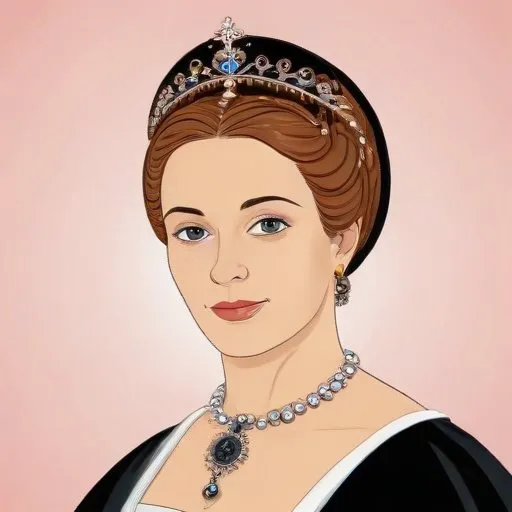
Holy Roman Empress and Queen of Spain, known for her strong political influence and role in shaping European history through strategic marriages and alliances.
Maria of Austria, Holy Roman Empress, was one of the most influential women of the 16th century, revered for her unwavering dedication to Catholicism and her remarkable regency skills, which earned her the respect of her contemporaries and secured her place in history. As the empress consort of Maximilian II, Holy Roman Emperor, King of Bohemia and Hungary, Maria played a pivotal role in shaping the fate of the Holy Roman Empire, while her strong personal views and policies left an indelible mark on European politics.
Born on June 21, 1528, in Madrid, Spain, Maria was the daughter of Charles V, Holy Roman Emperor and King of Spain, and Isabella of Portugal. Growing up in Toledo and Valladolid, Maria developed a strong bond with her siblings, Philip and Joanna, despite her father's frequent absences. This close-knit family environment instilled in her a sense of responsibility and loyalty that would serve her well in her future roles.
In 1548, at the tender age of 20, Maria married her first cousin, Archduke Maximilian, and was appointed regent of Spain in the absence of her father, Emperor Charles V. For three years, Maria skillfully navigated the complexities of Spanish politics, earning the respect of her people and demonstrating her ability to lead. When her father returned to Spain, Maria continued to wield significant influence, acting as regent again from 1558 to 1561 during the absence of her brother, King Philip II.
In 1552, Maria and Maximilian moved to the court of Maximilian's father in Vienna, where they lived until Ferdinand I's death in 1564. Upon Maximilian's succession as Holy Roman Emperor, King of Bohemia and Hungary, Maria became the Holy Roman Empress, a position she held until her husband's death in 1576. As empress, Maria remained steadfast in her Catholic faith, often disagreeing with Maximilian's more tolerant religious views. Despite their differences, Maria maintained a strong influence on her husband's policies, surrounding herself with a circle of devout Catholic courtiers.
Maria's remarkable life of duty and devotion left an enduring legacy in the realms of politics and faith. As a powerful female regent and empress, she paved the way for future generations of women in leadership positions. Her unwavering commitment to Catholicism helped shape the Holy Roman Empire's religious landscape, while her strong personal views influenced the course of European history.
"I am not a queen, I am a servant of the Church."
Maria's life and reign occurred during a time of great upheaval, marked by the Protestant Reformation and the Habsburg-Ottoman Wars. Despite these challenges, Maria remained a steadfast defender of Catholicism, earning her the admiration of her contemporaries and cementing her place in history as one of the most influential women of the 16th century.
Born in 1459
First Holy Roman Emperor to rule simultaneously as King of the Romans and King of Spain, known for uniting fragmented German states and establishing the Habsburg dynasty.
Born in 1500
Ruling over a vast empire from 1519 to 1556, he was a powerful and influential leader who played a crucial role in shaping European politics and religion. He is most known for his efforts to unify Christian Europe and defend it against the Ottoman Empire.
Born in 1503
The first Habsburg to rule the Holy Roman Empire, he unified Austria and introduced the concept of a hereditary monarchy, shaping European politics for centuries to come.
Born in 1451
Unified the Spanish kingdoms, sponsored Christopher Columbus's voyage to the Americas, and established the Spanish Inquisition.
Born in 1380
Unified the Crown of Aragon, ruling over a vast territory in eastern Spain, and sponsored the voyages of Christopher Columbus, leading to the discovery of the New World.
Born in 1338
The King of France from 1364 to 1380, known for his military victories and rebuilding of Paris, earning him the nickname "Charles the Wise".
