


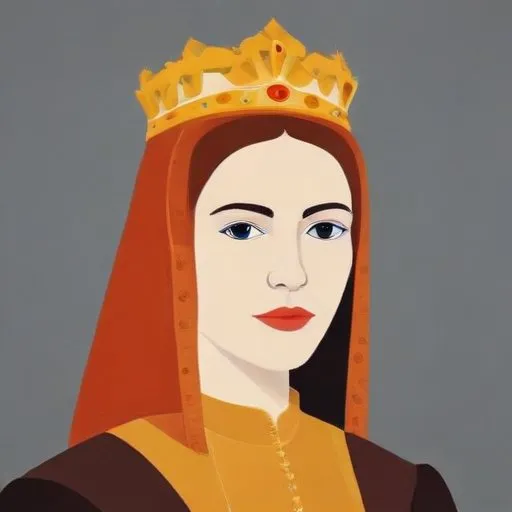
Portuguese infanta who married King Alfonso X of Castile, becoming queen and playing a key role in Castilian politics and diplomacy. She's known for her strong will and influence on her husband's decisions.
Maria of Portugal, Queen of Castile, is best known for her tumultuous marriage to Alfonso XI of Castile and her subsequent rise to power as a monarch in her own right. Born on February 9, 1313, Maria's life was marked by royal intrigue, power struggles, and a determination to assert her influence in a male-dominated world.
In 1328, Maria married Alfonso XI of Castile, a union that was meant to strengthen ties between the Portuguese and Castilian monarchies. As part of her dowry, Maria received the territories of Guadalajara, Talavera de la Reina, and Olmedo, which would later become crucial in her bid for power.
However, Maria's marriage to Alfonso was far from happy. Alfonso's relationship with his mistress, Leonor de Guzmán, produced ten children, including the future King Henry II of Castile. Maria, on the other hand, was relegated to a life of seclusion, often residing at the Royal Monastery of San Clemente in Seville.
In 1335, Maria returned to her father, King Afonso IV of Portugal, who demanded that Alfonso separate from Leonor. Although the peace treaty of Seville in 1340 seemed to secure Alfonso's promise to do so, he soon returned to his mistress, leaving Maria to seek her own path to power.
After Alfonso's death in 1350, Maria secured a position of influence by exerting control over the leader of her son's council, Joo Afonso de Albuquerque. She then ordered the murder of Alfonso's mistress, Leonor de Guzmán, in 1351, solidifying her grip on power.
Maria's involvement in the rebellion against her son in 1354 demonstrated her willingness to take bold action to protect her interests. Although she was eventually forced to return to Portugal, Maria's determination to assert her authority as a queen in her own right left a lasting impact on the monarchies of Castile and Portugal.
Maria executed a will in Valladolid on November 8, 1351, which provides a glimpse into her final wishes and legacy. She died on January 18, 1357, leaving behind a complex and fascinating legacy as a queen who refused to be defined by her marriage or her circumstances.
Maria of Portugal, Queen of Castile, remains an important figure in the history of medieval Europe, a testament to the power and determination of women in a time when they were often relegated to the shadows.
Born in 1380
Unified the Crown of Aragon, ruling over a vast territory in eastern Spain, and sponsored the voyages of Christopher Columbus, leading to the discovery of the New World.
Born in 1451
Unified the Spanish kingdoms, sponsored Christopher Columbus's voyage to the Americas, and established the Spanish Inquisition.
Born in 1469
King of Portugal from 1495 to 1521, known for sponsoring Vasco da Gama's voyage to India, establishing trade routes, and promoting the Portuguese Renaissance.
Born in 1500
Ruling over a vast empire from 1519 to 1556, he was a powerful and influential leader who played a crucial role in shaping European politics and religion. He is most known for his efforts to unify Christian Europe and defend it against the Ottoman Empire.
Born in 1455
King of Portugal from 1481 to 1495, known for his centralizing policies, establishing a strong monarchy, and sponsoring explorers like Bartolomeu Dias and Vasco da Gama.
Born in 1554
The last monarch of the House of Aviz, who disappeared during a crusade in Morocco, leading to a succession crisis that changed the course of Portuguese history. He's a legendary figure, symbolizing a lost golden age.
