


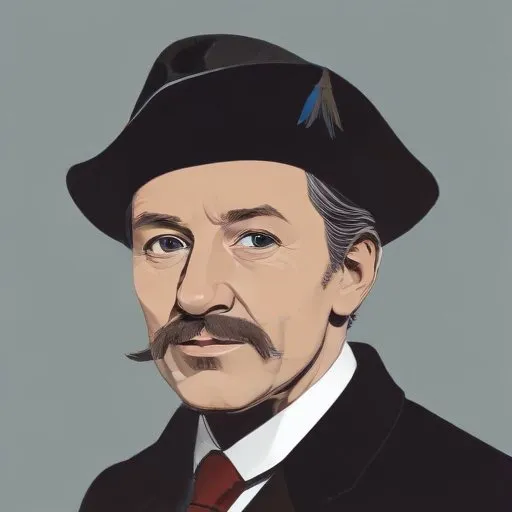
A renowned mountaineer, cartographer, and politician who mapped the Karakoram range and served as President of the Alpine Club. He's most famous for his expeditions and cartographic work in the Himalayas.
Martin Conway, 1st Baron Conway of Allington, was a multifaceted figure known for his contributions to the fields of art criticism, politics, cartography, and mountaineering. His diverse interests and achievements earned him recognition as a versatile and accomplished individual of his time.
Conway was born on April 12, 1856, in Rochester, England, to Reverend William Conway. He was educated at Repton and Trinity College, Cambridge, where he studied mathematics and developed a close friendship with Karl Pearson. It was during his time at Cambridge that Conway met Henry Bradshaw, a librarian, and John Ruskin, who introduced him to the world of art and the Alps.
Conway's fascination with art led him to become a respected art critic. He wrote extensively on the subject, and his publications include History of the Woodcutters of the Netherlands in the Fifteenth Century (1884), Mountain Memories (1920), Art Treasures of Soviet Russia (1925), and Giorgione as a Landscape Painter (1929). His writing showcased his deep understanding of art and his ability to communicate complex ideas with clarity.
Conway's passion for mountaineering led him to undertake several expeditions to Europe, South America, and Asia. He was a member of the Alpine Club and served as its president from 1902 to 1904. In 1892, he participated in an expedition to the Baltoro Kangri, claiming a world altitude record of 23,000 ft (7,010 m). Later measurements revised the height to 22,322 ft (6,804 m), but Conway's achievement remained a testament to his adventurous spirit.
Conway's interests extended to politics, and he held several university positions. From 1918 to 1931, he represented the Combined English Universities as a Conservative member of the House of Commons. His experience in politics and academia equipped him with a unique perspective on the intersection of art, education, and governance.
Conway's contributions to art, politics, and mountaineering have left a lasting impact on modern society. His writings on art continue to inspire new generations of art enthusiasts, while his expeditions paved the way for future explorers. As a politician, he worked to promote education and the arts, leaving a legacy that transcends his individual achievements.
Conway's personal life was marked by significant milestones, including his marriage and the birth of his children. He was knighted in 1895 and later created 1st Baron Conway of Allington in 1931. Throughout his life, Conway remained committed to his passions, pursuing a path that was both fulfilling and remarkable.
These quotes, though unverified, are attributed to Conway and reflect his deep appreciation for art, nature, and the human experience.
Conway's remarkable life and achievements often lead to speculation about what he might have accomplished had he lived longer. Some predict that he would have continued to explore new territories, both physically and intellectually, leaving behind a legacy that would have rivaled that of his contemporaries.
Conway was recognized for his contributions to art, politics, and mountaineering through various awards and honors. These include his knighthood in 1895 and his creation as 1st Baron Conway of Allington in 1931.
Martin Conway, 1st Baron Conway of Allington, was a true Renaissance man, whose diverse interests and achievements continue to inspire and fascinate us today. His legacy serves as a testament to the power of human curiosity and the importance of pursuing one's passions.
Born in 1886
An English lieutenant and mountaineer who attempted to conquer Mount Everest in 1924, famously disappearing during the attempt, sparking a decades-long mystery. He's known for his bravery and pioneering spirit in exploration.
Born in 1902
British mountaineer who attempted to be the first to climb Mount Everest, but tragically disappeared during the expedition. He's famously known for his mysterious and untimely death on the mountain.
Born in 1890
A pioneering geologist and mountaineer who made significant contributions to the field of geology and was part of the first expedition to attempt to climb Mount Everest in 1924. He's also known for his remarkable eyewitness account of George Mallory and Andrew Irvine's ill-fated climb.
Born in 1840
A renowned mountaineer, explorer, and author, known for being the first person to ascend the Matterhorn, a feat that cost him four lives, and for his detailed illustrations of the Alps.
Born in 1820
A pioneering physicist who made significant contributions to the discovery of the greenhouse effect and the behavior of gases, and an accomplished mountaineer who conquered several Alpine peaks.
Born in 1863
Led British expeditions to Tibet, discovering hidden cities and mapping uncharted territories, earning fame as a daring explorer and cartographer.
